
Acrylic Reinforced Coating System Foam
- Manufacturer
- Metacrylics
- Product
- Acrylic Reinforced Coating System Foam
- Status
- Current
- Market
- United States
- Last verified
- September 20, 2026
Overview
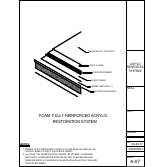
Acrylic Reinforced Coating System Foam is a Metacrylics assembly for spray polyurethane foam roofing. It belongs to the manufacturer's family of fully reinforced acrylic restoration systems for commercial roofs. The drawing for the system is sheet A-07, titled Foam Fully Reinforced Acrylic Restoration System, dated 09-25-17.
The finish chemistry is acrylic. The coating is water-based and is applied over an existing foam roof. The manufacturer's installation spec book lists Spray Polyurethane Foam (SPF) among its coating systems, with 10 to 30 year system options on pages 37 to 40 of the book.
System layers
The drawing shows the build from the existing foam roof upward:
- Existing foam roof
- Primer (see note 1 on the drawing)
- Acrylic base coat
- Polyester fabric embedded in the base coat
- Acrylic base coat over the fabric
- Metacrylics topcoats
Note 1 on the drawing states that the primer is not required if Acrylic Clear Base is used as the acrylic base to apply the polyester fabric. Note 2 states that all rooftop penetrations, drains, scuppers, flashings, skylights and perimeter edge metal are sealed and reinforced by 3-coursing with Metacrylics Acrylic Gel and polyester fabric.
On the manufacturer's website, the published acrylic assembly for a spray polyurethane foam surface is a prepared foam surface, Acrylic Clear Base or a specified primer, an acrylic base coat, polyester fabric and an acrylic top coat. The exposed top coat is the renewable weathering surface. A silicone alternative uses Roof & Tile Primer where required, Silicone Gel at details and High Solids Silicone.
Data sheets and technical documents
Current manufacturer system specifications, application guidelines and component data sheets matched to this assembly.
Current files
Archived files
No older reviewed revisions are archived for this product yet.
Roof & Tile Primer
Roof & Tile Primer is the primer data sheet that accompanies this system. It is a clear, water-based acrylic primer with penetrating characteristics. It improves the adhesion of applied elastomeric coatings to existing surfaces. Common substrates include wood, asphalt-based surfaces, concrete, stone, slate, metal, tiles, fiberglass, stucco and acrylic-coated surfaces as common substrates.
The primer is white as a liquid and dries clear and not tacky. Published properties are:
- Solids: 16 to 20
- pH: 7 to 8
- Viscosity at 23 degrees C (Brookfield RV, spindle 5, 50 rpm): 1500 to 6000 cps
- Density at 23 degrees C: 1.03 g/cm3
- Dispersion type: anionic
- Freeze/thaw stability: not resistant
- Film elongation at break: 700 percent
- Film glass transition temperature (DSC): 17 degrees C
- Water absorption: 5 percent
The coverage rate is 0.25 to 1 gallon per 100 sq. ft. for both spray and roller application. Spray application uses a .031 spray tip. Drying time is 1 to 4 hours. The primer is not applied when rain or freezing weather is imminent within 24 hours, during fog or drizzle, or when temperatures are consistently below 40 degrees F. It is not thinned or mixed with solvents. Tools are cleaned with water, and the material is stored where the temperature stays above 40 degrees F.
Base coat and fabric
The base coat is Metacrylics Acrylic Gray Base, a gray, water-based acrylic elastomeric coating that is protected from ultraviolet light by an Acrylic White or color coat. Spray application is 2 to 3 gallons per 100 sq. ft., then the polyester fabric is embedded, then 2 gallons per 100 sq. ft. goes over the fabric. The total is 4 to 5 gallons per 100 sq. ft., sprayed with a .061 tip, with 24 to 48 hours of drying time. Acrylic Base Quick Set is an additive premixed by Metacrylics that gives rain resistance at 40 degrees F and 80 percent relative humidity within 2 hours or less.
The reinforcing fabric is Metacrylics Stitchbond Polyester Fabric, offered as T272, T325, T326 and W201. T272, T325 and T326 rolls are 40 inches wide by 324 feet long, with lap lines for one-ply and two-ply application. The standard 10 square roll is 10.8 squares gross and 10.0 squares net applied with a 3 inch single-ply overlap, and weighs about 20 to 22 pounds. W201 rolls are 42 inches wide by 300 feet long.
Topcoat
The topcoat data sheet is Metacrylics Extreme Performance Plus Acrylic White. It is a white, water-based acrylic elastomeric coating. Elongation at break at 23 degrees C is 592.63 percent by ASTM D6083-05e1 and 521.12 percent by ASTM D412 (Die C). Cool Roof Rating Council testing under C-1371 gives solar reflectance 0.90 and thermal emittance 0.88, with a solar reflective index of 114 (CRRC Seller ID 0660). The coating is Title 24 compliant.
Spray application is two coats at 1.5 gallons per 100 sq. ft., a total of 3 gallons per 100 sq. ft., with a .035 to .039 spray tip and 12 to 24 hours between coats. Roller application is 2 to 3 coats at 1.33 to 1.5 gallons per 100 sq. ft. per coat. For non-skid areas, sand is broadcast over the wet coating, or 1/2 gallon of #30 mesh sand or rubber granules is mixed into 2-1/2 gallons of coating. The coating weighs 11.3 pounds per gallon and has a VOC content of 27.5 grams per liter.
Foam surface conditions
The manufacturer's website lists these conditions on spray polyurethane foam roofs: UV-eroded or exposed foam cells, bird damage and punctures, and wet or poorly bonded foam. Field preparation steps listed are to remove and replace wet or unsound foam, shape repairs so they drain without hard edges, and clean, dry and detail all penetrations. Primer is not applied over an existing silicone surface.
Wet acrylic is extremely slippery when stepped on. Areas shaded from sunlight dry very slowly, and seventy-two hours or more may be required for curing when temperatures are below 55 degrees F.
Spec book systems and rates
The spec book gives four foam systems. Each starts with a pressure wash, and all saturated foam areas are removed and replaced with similar material of equal thickness. Where the roof cannot be pressure washed, the surface is washed with TSP or a similar cleaner to remove oxidation and residue. Ponding areas are reinforced by embedding fabric in wet Clear Base and applying 1 gallon per square over it. Between white coats, 24 to 48 hours of cure is allowed.
- 10-year system: Clear Base 2 gallons per square; Acrylic White 3.5 gallons per square in two coats of 1.75 gallons; no fabric except at ponding areas; Clear Base cures 24 to 48 hours
- 15-year system: Clear Base 2 gallons per square; Acrylic White 5 gallons per square in three coats of 1.66 gallons; Stitchbond fabric 1 square per square
- 20-year system: Clear Base 2 gallons per square; Acrylic White 6 gallons per square in three coats of 2 gallons; Stitchbond fabric 1 square per square
- 30-year system: Clear Base 6 gallons per square with two fabric layers; Acrylic White 8 gallons per square in four coats of 2 gallons; Stitchbond fabric 2 squares per square; 5-course penetration details
Foam release points
Release points listed on the manufacturer's foam page are that no friable foam remains, that repairs are compatible and fully cured, and that the coating film is continuous across transitions. Existing acrylic-coated foam may need primer after adhesion testing.
Penetration and edge details
On foam roofs the penetration sequences from the spec book are as follows. Scuppers take gel inside and outside, with a 9 to 20 inch square of fabric embedded at least 4 inches into the scupper and a gel cover coat. Pitch pockets are filled with gel, 3-coursed over the top and down to the base at least 3 inches onto the roof, and gel runs 10 inches along the penetration leaving the pocket. Drains are 3-coursed with gel and fabric into the pipe at least 2 inches, using a 20 or 40 inch square of fabric with a hole cut for the drain.
Tested properties of the base coat
The Acrylic Gray Base data sheet publishes these values for the coating:
- Wind uplift: 105 PSF, Section 6 of ANSI A58.1
- Fire resistance: Class A, ASTM E-108, UL Standard 790
- Low temperature flexibility: pass 1 inch at minus 40 degrees F, ASTM C836
- Elongation: 149 percent average (81 mils, including 10 mil stitchbonded polyester fabric)
- Hardness: Shore A 41, ASTM D-676
- Permeability: 0.016 perms, ASTM D1653 (81 mils dry film thickness)
- Weight: 12.1 pounds per gallon; solids 67.9 percent by weight; VOC 11.73 grams per liter
Temperature cycling and penetration testing used 25 continuous cycles under the ICBO Acceptance Criteria for Special Roofing Systems. The result was a pass, with a thickness change of less than 1 percent and no tearing or cracking. Like other low-slope roof coating assemblies, the system is built from a primer, base coats, fabric and topcoats.
Related products
 Illustration
SMEA-2P-14-3G-6xE — Acrylic-surfaced reinforced roof system
884 Tropi-Cool Silicone Roof Sealant
Duro-Last EV Fleece PVC Membrane
Illustration SM-12-3G-3E — Acrylic-surfaced reinforced roof system
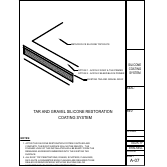
Silicone Roof Coating System Tar and Gravel Hybrid System Reinforced Acrylic with Silicone Top Coat
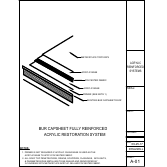
Acrylic Reinforced Coating System BUR Capsheet
Contribution history
Published changes remain in this permanent record. Corrections create a new entry instead of deleting earlier history.
- September 21, 2026 at 8:48 amLibrary Record
Acrylic Reinforced Coating System Foam — initial source record
Created the system record and matched the current manufacturer system specification, application guidance and component data sheets.
By Tom · Verified Primary Source
Sources: Official Metacrylics Acrylic Reinforced Coating System Foam system page