
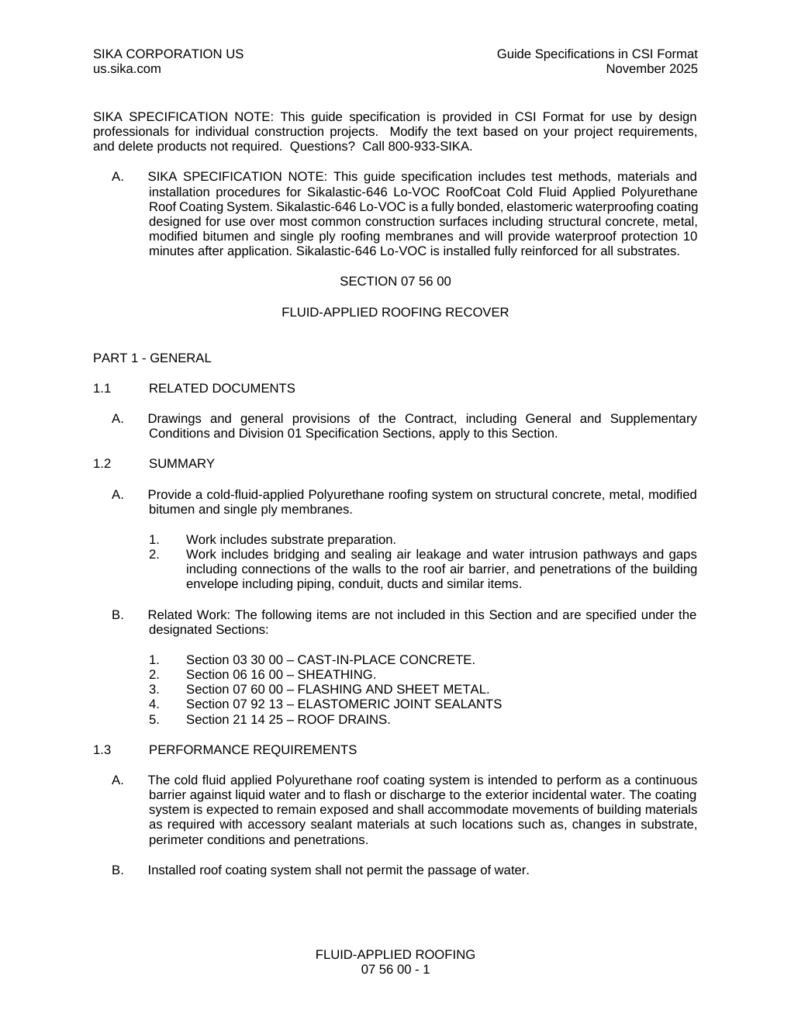
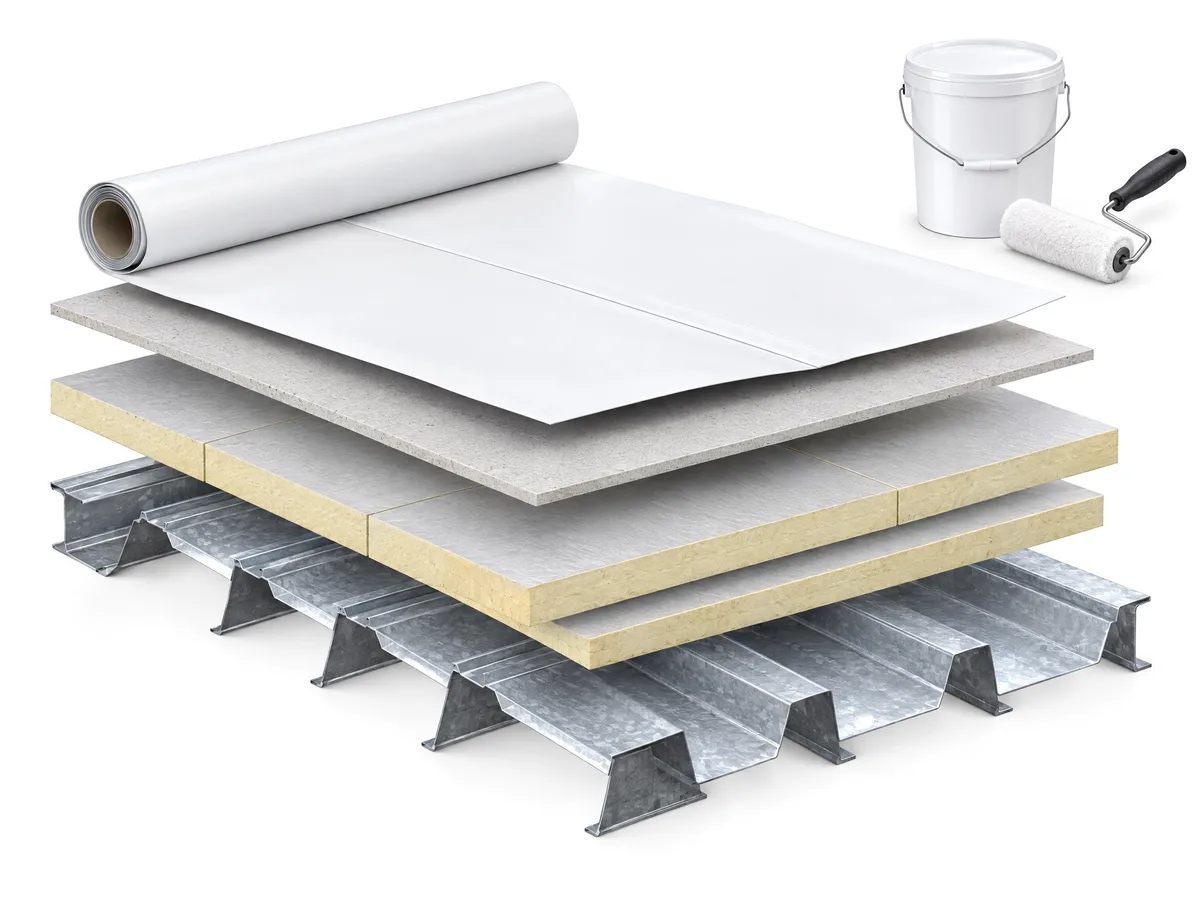
07 56 00 Fluid-Applied Roofing Recover Sikalastic-646
- Manufacturer
- Sika
- Product
- 07 56 00 Fluid-Applied Roofing Recover Sikalastic-646
- Status
- Current
- Market
- United States
- Last verified
- September 20, 2026
Overview
Sikalastic-646 Lo-VOC is a cold liquid-applied, single-component, aliphatic polyurethane roof coating made by Sika Corporation. Its chemistry is moisture-triggered, and the coating is low odor. It is part of the Sikalastic RoofCoat roofing systems and is written into the 07 56 00 Fluid-Applied Roofing Recover guide specification for structural concrete, metal, modified bitumen and single-ply membranes. The coating meets ASTM C836.
Listed uses are roof recover, roof maintenance, emergency roof repair and roof walkways. The coating is applied fully bonded. Both defined systems are fully reinforced with Sika Reemat, and the coating is vapor permeable, UV resistant and non-yellowing.
Coating properties
- Packaging: 5 gal. (19 L) pail.
- Colors: white, steel gray and mushroom, with custom colors available at a minimum order quantity.
- Shelf life: 15 months, stored dry between 35°F and 77°F (2 to 25°C) and conditioned to 50 to 77°F (10 to 25°C) before use.
- Density: 11.9 lb./gal.
- VOC content: 38 g/l (ASTM D2369).
- Solids by volume: 89% (ASTM D2697).
- Resistance to static puncture: 55 lb/f (ASTM D5602).
- Tensile strength: 700 psi.
- Elongation at break: 250% (ASTM D412).
- Tear strength: 70 lbf/in (ASTM D624).
- Solar reflectance: 0.88 (ASTM C1549). Solar Reflectance Index: 108 (ASTM E1980), for white.
- Service temperature: -22 to 176°F (-30 to 80°C), intermittent.
- Chemical resistance: most common roofing contaminants, oils, grease, and dilute acids and bases. The guide specification adds gasoline, paraffin, fuel oil, mineral spirits, acid rain and detergents, and notes that some low molecular weight alcohols can soften the coating.
Data sheets and technical documents
Current manufacturer system specifications, application guidelines and component data sheets matched to this assembly.
Current files
Archived files
No older reviewed revisions are archived for this product yet.
Reinforced system build
Two system lengths are defined, and both use the same 45 wet mil base coat with a Reemat embedment.
- RoofCoat 15 (15 year): base coat at 45 wet mils (about 2.75 gal per 100 SF), Reemat, and a top coat at 20 wet mils (1.25 gal per 100 SF). Total dry film is about 58 mils.
- RoofCoat 20 (20 year): base coat at 45 wet mils (about 2.75 gal per 100 SF), Reemat, and a top coat at 30 wet mils (2.0 gal per 100 SF). Total dry film is about 67 mils.
Coverage rates are optimal figures that vary with temperature, surface roughness, porosity, aggregate selection, embedment and application technique. The Reemat mat is made of random fiberglass strands that conform to the surface. Its role in the system is greater impact resistance and greater resistance to excessive thermal and structural movement while keeping the elasticity and film integrity of the membrane. The Sika LAM TM-Roofing standard warranty applies, with a materials warranty of at least one year from Substantial Completion and system warranties of 15 or 20 years.
Primers by substrate
The priming guide for this coating covers a wide range of substrates. New cementitious substrates must be Portland-based and cured at least 28 days.
- Concrete and lightweight structural concrete: Sikalastic Concrete Primer Lo-VOC, DTE Primer, GDC Primer, EP Primer/Sealer or EP Primer Rapid. GDC Primer is the one named when substrate moisture is above 4%.
- Cement and gypsum-based roof boards, brick and stone: Concrete Primer Lo-VOC, EP Primer/Sealer or EP Primer Rapid.
- Bituminous substrates, including asphalt, felts, coatings and SBS or aged APP cap sheets: EP Primer/Sealer or EP Primer Rapid. Volatile bitumen can discolor the coating if it is not primed.
- PVC membranes, including Sarnafil and Sikaplan: EP Primer/Sealer.
- Hypalon: Sika Bonding Primer.
- TPO and EPDM: Sikalastic EPDM / TPO Primer Lo-VOC.
- Metals (aluminum, galvanized, cast iron, copper, lead, brass, stainless steel, steel, zinc), pre-coated metal, paints and coatings, and aluminized solar reflective coatings: EP Primer/Sealer or EP Primer Rapid.
- Unglazed roof tiles, fiberglass, sprayed or slab polyurethane foam, and wood: EP Primer/Sealer or EP Primer Rapid.
Substrate preparation
Cementitious surfaces are abrasive blast cleaned or scarified to an open texture of CSP 2 to 4 under ICRI guidelines. Applying primer and embedment coat while concrete temperature is falling or stable reduces outgassing. Ferrous metals are ground or blast cleaned (SSPC-SP3 to SP11), and stainless steel is abraded to create an anchor profile. The guide specification cleans exposed drain bowls and pipes by power tool cleaning to SSPC SP-11 and requires all bituminous substrates to be fully reinforced with Reemat. Existing Sikalastic systems and Sikaplan or Sarnafil membranes are pressure washed at about 2000 psi with biodegradable non-sudsing detergent and left to dry. Timber decks take an added layer such as plywood, insulation or cover board.
Detailing
Detail treatment depends on the condition.
- Non-structural cracks up to 1/16 in. need no detailing.
- Cracks between 1/16 in. and 1/4 in. are routed and sealed with Sikaflex-11 FC, then covered with a 30 to 35 mil resin layer embedding 3 in. Sika Flexitape Heavy, or with Sika Joint Tape SA once the sealant cures.
- Metal seams, plywood and board joints get a 30 to 35 mil resin layer embedding 3 in. or 6 in. Flexitape Heavy.
- Transitions between dissimilar materials get 30 to 35 mils of resin embedding 6 in. Flexitape Heavy centered over the edge.
- Horizontal-to-vertical transitions take a 1/2 in. cant bead of Sikaflex-11 FC, then 30 to 35 mils of resin embedding 6 in. Flexitape Heavy.
- Lap seams are covered with 3 in. or 6 in. Joint Tape SA or Flexitape Heavy embedded in 30 to 35 mils of resin.
Sika Flexitape Heavy is a nylon mesh for structural cracks, expansion joints and transitions. Sika Joint Tape SA is a self-adhering polymeric rubberized tape with a woven polyester facer; for this system it is noted for metal roofs.
Application
The coating needs no mixing. The base resin is applied with a 1/2 in. nap phenolic resin core roller, or it can be squeegee or spray applied and then backrolled before the mat goes in. Reemat is placed in the wet base layer with seams overlapped at least 2 in., and a wet roller saturates it completely. After about 5 minutes the binder dissolves and the fiber strands conform to irregular surfaces. The base layer cures 12 hours at 70°F and 50% R.H., or until tack free, before the top layer. The top layer goes on within 7 days; past that window the surface is cleaned and primed with Sika Concrete Primer Lo-VOC or Sika Reactivation Primer.
Application conditions are 41 to 95°F (5 to 35°C) ambient air, 80% R.H. maximum, and 41 to 140°F (5 to 60°C) substrate, with substrate and uncured coating at least 5°F (3°C) above the dew point. Substrate moisture is 4% or less by Tramex meter. Pot life in an opened container is about 1 to 2 hours before a film forms at 75°F and 50% R.H.
- At 40°F and 50% R.H.: rain resistant in 1 hour, touch dry in 12 hours, full cure in 24 hours, overcoat after 18 hours.
- At 50°F and 50% R.H.: rain resistant in 1 hour, touch dry in 6 hours, full cure in 18 to 24 hours, overcoat after 8 hours.
- At 70°F and 50% R.H.: rain resistant in 1 hour, touch dry in 4 hours, full cure in 12 to 18 hours, overcoat after 6 hours.
Walkway options and limits
Two aggregate options serve traffic areas. The seed and back roll option applies a 15 mil wet film of resin to the cured system, seeds it with kiln-dried, iron-free aggregate and back rolls to encapsulate the aggregate; it is intended for maintenance roof walkways. The full broadcast and seal option applies 15 mils of resin, broadcasts aggregate to rejection, removes the excess after cure and seals with a further 15 mil coat. This fits areas that need both slip resistance and physical protection of the membrane.
The coating is not applied on grade concrete decks, under continuous immersion, or directly under cementitious products such as tile mortar. Unvented metal pans, split or sandwich slabs, cinder fill decks and lightweight insulating concrete overlays need added deck evaluation. Indoor use requires ventilation to prevent odors from leaving the work area. The system suits the reinforced liquid-applied membranes used in roof recover work.
Installing this in San Antonio or Austin?
We install protective coatings for metal roofs and cladding on commercial and industrial buildings from our Bulverde office.
Related products
Acrylic Roof Restoration Coating System Foam
Silicone Roof Coating System EPDM
 Illustration
SM-1P-XE — Acrylic-surfaced reinforced roof system
Illustration Pro-Grade 988 Silicone Roof Coating
Illustration 07 56 00 Fluid-Applied Roofing Recover Sikalastic-515
Illustration Sikalastic 702 – 701 SF Fluid-Applied Protected or Exposed Membrane Roofing-Waterproofing
Contribution history
Published changes remain in this permanent record. Corrections create a new entry instead of deleting earlier history.
- September 21, 2026 at 8:48 amLibrary Record
07 56 00 Fluid-Applied Roofing Recover Sikalastic-646 — initial source record
Created the system record and matched the current manufacturer system specification, application guidance and component data sheets.
By Tom · Verified Primary Source
Sources: Official Sika 07 56 00 Fluid-Applied Roofing Recover Sikalastic-646 system page