Silicone Roof Coating System EPDM
- Manufacturer
- Metacrylics
- Product
- Silicone Roof Coating System EPDM
- Status
- Current
- Market
- United States
- Latest file date
- September 25, 2017
- Last verified
- September 20, 2026
Overview
Silicone Roof Coating System EPDM is a Metacrylics system assembly for EPDM roof membranes. It is a silicone roof coating restoration system with silicone finish coats, published for existing black EPDM roofs.
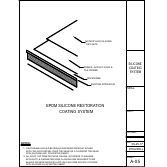
The assembly is published as drawing A-05, titled EPDM Silicone Restoration Coating System, dated 09-25-17. From the substrate upward the drawing shows the existing EPDM roof, an EPDM rinse, an Acrylic Roof & Tile Primer, and Metacrylics silicone topcoats.
Assembly and layers
Drawing A-05 requires field seams to be sealed and reinforced with Silicone Gel over the seam or by 3-coursing the seam with silicone and polyester fabric. Roof top penetrations, drains, scuppers, flashings, skylights and perimeter edge flashing are required to be sealed or reinforced in the same way.
The silicone application book gives the EPDM systems as 10-, 15- and 20-year systems. All three start with the same pretreatment steps. The roof is cleaned of debris, Metacrylics EPDM Rinse is applied at 0.2 gallons per square (1 SQ = 100 sq. ft.) and left for 20 minutes, and the roof is then pressure washed thoroughly. Metacrylics Clear Acrylic Base or Roof & Tile Primer follows at 0.5 gallons per square, with 4 to 12 hours to cure.
- 10-year system: HS Silicone White at 2 gallons per square in a single application. Vertical surfaces need 2 coats at 1 gallon per square per coat, with 24 hours between applications. Polyester fabric is used on all seams, and penetration details come after priming.
- 15-year system: 2.5 gallons per square over the Clear Acrylic Base in two applications of 1.25 gallons per square. Silicone Gel is used on field seams and penetrations, and penetration details come before the primer.
- 20-year system: 3 gallons per square over the Clear Acrylic Base in two applications of 1.5 gallons per square, with 24 hours to cure between applications.
Data sheets and technical documents
Current manufacturer system specifications, application guidelines and component data sheets matched to this assembly.
Current files
Archived files
No older reviewed revisions are archived for this product yet.
EPDM Rinse
Metacrylics EPDM Rinse is a rinseable primer technology for elastomeric roof coatings. It is a low viscosity, sprayable liquid that pre-treats a black EPDM rubber roof membrane before power washing and coating, and it is designed for use with Metacrylics acrylic or silicone coating products.
It is a clear liquid, pink to purple in color, with a mild odor, pH 6–7, specific gravity 1.01 and wet density of 8.46 lbs/gal. It is completely soluble in water, has a neutral pH, and uses APEO-free surfactants.
Laboratory wet adhesion of a Metacrylics roof coating on black EPDM was measured by ASTM C794 with a two-coat application at a minimum of 18–20 dry mil. The results are below.
- New EPDM: 0.4 pli after a water pressure wash alone, and 1.2 pli after EPDM Rinse followed by a pressure wash.
- Aged EPDM: 0.5 pli after a water pressure wash alone, and 1.4 pli after EPDM Rinse followed by a pressure wash.
- A white coating at 20 dry mil with embedded scrim failed adhesively after water-only power washing, and failed cohesively with fabric delamination after the EPDM Rinse treatment.
The rinse is spread at 500 ft2 per gallon and remains on the surface for a minimum of 20 minutes, and up to 2 hours. The membrane is cleaned with a commercial power washer at 2000–3500 psi, slowly and close to the surface to remove mica and inorganic release agents. The final rinse water runs clear with no soap bubbles, and the EPDM surface is dry, with no visible dampness, before the coating goes on.
During pressure washing, one part of the rinse is diluted with 300 parts of water. The undiluted product is classed of low concern to aquatic invertebrates and fish (LC/EC50 above 100 mg/L).
Details on EPDM roofs
The book's penetration instructions apply to the rooftop items on an EPDM roof. For scuppers and drains, old asphalt, mastic and roofing materials are removed from around and inside the scupper, and for drains the drain screen, clamp ring and screws are removed. Acrylic Clear Base is the primer.
For drains, Silicone Gel goes inside the drain pan and down the drain pipe a minimum of 2 inches and around the drain a minimum of 8 inches. The alternative is a 3-course with Acrylic Gel and fabric into the pipe at least 2 inches, using a 20 inch or 40 inch square piece of fabric with a hole cut for the drain.
For HVAC ducting, the ducts are pressure washed, joints get Silicone Gel or a 3-course, and 2 gallons per square of HS Silicone goes on in two applications of 1 gallon per square.
High Solids Silicone topcoat
High Solids Silicone is a single-component silicone elastomer with 100% silicone content.
It carries 98% solids by volume and 98% by weight.
Shelf life is 6 months unopened.
No degradation is recorded after 10,000 hours of QUV weathering.
Permanent set at break is 1.0%, heat-aged permanent change is 0%, and tension set at 100% is 0% by ASTM D-412.
The liquid has a viscosity of 8,000–11,000 cps, a specific gravity of 1.20 and a flash point of 280°F.
Directly over modified bitumen, asphalt or coal tar built-up roofing, an appropriate primer is required.
Ponding water does not affect the membrane. The National Roofing Contractors Association recommends that all roof systems be designed and built for positive drainage.
The spray gun is a 5000 psi unit with a reverse-a-clean tip, a minimum orifice of .030 and a 50° fan.
Hose used for acrylics or other waterborne coatings is excluded, since its liner absorbs moisture and initiates the silicone cure.
Walkway pads are recommended where the roof has foot traffic, for added protection and slip resistance.
A variable speed drill with a jiffy mixer suspends settled pigments in 5 gal pails and 55 gal drums.
It can serve as a topcoat over polyurethane elastomeric base coats where improved traffic and impact resistance is required.
Surface preparation calls for clean, dry surfaces free of dust, dirt and oily residues, with loose rust removed from metal.
Silicone Gel
Silicone Gel is a single-component, moisture-cured liquid flashing membrane applied by brush, spatula or trowel at thicknesses up to 1/4 inch.
Substrates it can be used over include metal, spray polyurethane foam, smooth and granulated bitumen roofing, concrete and single-plies, along with flashings, fasteners, seams, scuppers and drains.
Coverage is 25 sq ft/gal.
The shelf life of unopened containers is 1 year.
Flash point is 142°F (ASTM D-56) and viscosity is 50,000 cps.
More than 250 wet mils (6350 μ) in one application risks pin holes and blistering.
Related products
 Illustration
SM-1P-XE — Acrylic-surfaced reinforced roof system
Illustration Pro-Grade 988 Silicone Roof Coating
Illustration CTG-3-1.5A — Aluminum-surfaced roof restoration system
UltraPly TPO Coated Metal
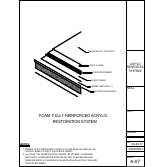
Acrylic Reinforced Coating System Foam
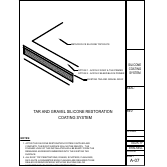
Silicone Roof Coating System Tar and Gravel Hybrid System Reinforced Acrylic with Silicone Top Coat
Contribution history
Published changes remain in this permanent record. Corrections create a new entry instead of deleting earlier history.
- September 21, 2026 at 8:48 amLibrary Record
Silicone Roof Coating System EPDM — initial source record
Created the system record and matched the current manufacturer system specification, application guidance and component data sheets.
By Tom · Verified Primary Source
Sources: Official Metacrylics Silicone Roof Coating System EPDM system page