
Acrylic Roof Restoration Coating System BRAI Torchdown
- Manufacturer
- Metacrylics
- Product
- Acrylic Roof Restoration Coating System BRAI Torchdown
- Status
- Current
- Market
- United States
- Last verified
- September 20, 2026
Overview
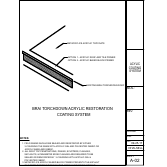
The Acrylic Roof Restoration Coating System BRAI Torchdown is the Metacrylics system for existing BRAI torch-down modified-bitumen roofs. It is published as sheet A-02, titled BRAI Torchdown Acrylic Restoration Coating System, dated 09-25-17.
It is one of the torch-down modified bitumen restoration systems.
Layers of the system
The section drawing has an existing BRAI torchdown roof, a primer, and Metacrylics acrylic topcoats. The primer is drawn as one of two options.
- Option 1: Acrylic Roof and Tile Primer.
- Option 2: Acrylic Bleed Block Primer.
The notes on the sheet cover three points: field seams are sealed and reinforced either with Acrylic Gel and polyester fabric by 3-coursing or with Acrylic Base and fabric; rooftop penetrations, drains, scuppers, flashing, skylights and perimeter edge flashing are 3-coursed with Acrylic Gel and polyester fabric; and the bleed block primer prevents asphalt oils from bleeding through the acrylic and discoloring it.
Data sheets and technical documents
Current manufacturer system specifications, application guidelines and component data sheets matched to this assembly.
Current files
Archived files
No older reviewed revisions are archived for this product yet.
Bleed Blocker Primer
Acrylic Bleed Blocker Primer is a water-based all-acrylic primer made to block asphalt bleed-through and improve adhesion. It is applied over aged built-up asphalt, modified bitumen, metal and concrete, and it screens ultraviolet light, which degrades the surface of asphalt materials. Dirt pick-up resistance is among its listed properties.
- Milky white liquid; total solids by weight 27.5 plus or minus 0.5 percent.
- pH 9.5 plus or minus 0.3; specific gravity 1.05; 8.76 lbs per US gallon.
- Glass transition temperature: -10 degrees C (14 degrees F).
- Brookfield viscosity: 100-400 cps.
- VOC: 37.5 to 50 grams per liter.
The film is applied at a minimum of 4 dry mils, about 1 gallon per square, and a second 8 dry mil coat may be needed on unaged asphalt. Aged surfaces can discolor temporarily, and the water-soluble discoloration disappears after a few rainfalls. Application is by spray, brush or roller, and it is not applied below 5 degrees C (40 degrees F), above 90 percent relative humidity, in expected rain, or when the temperature may fall below the dew point within 6 hours.
Waiting period and finish coats
New torch-down single-ply assemblies, and new glazed asphalt, wait 6 months or more before coating. The finish is Extreme Performance Acrylic White, a coating with elongation at break of 521.12 percent (ASTM D412, Die C) and a flexibility pass at 1 inch and -40 degrees F (ASTM C836). Spray application is two coats of 1.5 gallons per 100 sq. ft. using a .035 to .039 tip, with 12 to 24 hours between them.
Temperature limits apply: the white is not applied when temperatures are consistently below 40 degrees F, dries slowly below 55 degrees F, and needs 72 hours or more in shade. Chemical resistance covers 1 percent hydrochloric acid, diesel, salt, boric acid and petroleum ether with no effect, while gasoline causes some softening and spotting.
Acrylic Gel
Acrylic Gel seals the details named on the sheet. The mastic is white, gray or clear, contains no zinc oxide, and passed the temperature cycling and penetration test in 25 cycles, with samples averaging 1.626 before and 1.610 after weathering. It is applied over fabric in three courses with a 12 to 24 hour dry time, and it cannot be thinned.
Related products
Duro-Last PVC Membrane
 Illustration
Sikalastic-621 Vegetated Protected Membrane Roofing
Illustration Sikalastic-624 WP Fluid-Applied Membrane Waterproofing
Illustration SMAA-1P-7xE — All-acrylic reinforced roof system
Silicone Roof Coating System Foam
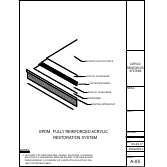
Acrylic Reinforced Coating System EPDM
Contribution history
Published changes remain in this permanent record. Corrections create a new entry instead of deleting earlier history.
- September 21, 2026 at 8:48 amLibrary Record
Acrylic Roof Restoration Coating System BRAI Torchdown — initial source record
Created the system record and matched the current manufacturer system specification, application guidance and component data sheets.
By Tom · Verified Primary Source
Sources: Official Metacrylics Acrylic Roof Restoration Coating System BRAI Torchdown system page