WCP-MTL1-3E — Metal roof acrylic restoration system
- Manufacturer
- Western Colloid
- Product
- WCP-MTL1-3E — Metal roof acrylic restoration system
- Status
- Current
- Market
- United States
- Latest revision
- 1105e
- Last verified
- September 20, 2026
Overview
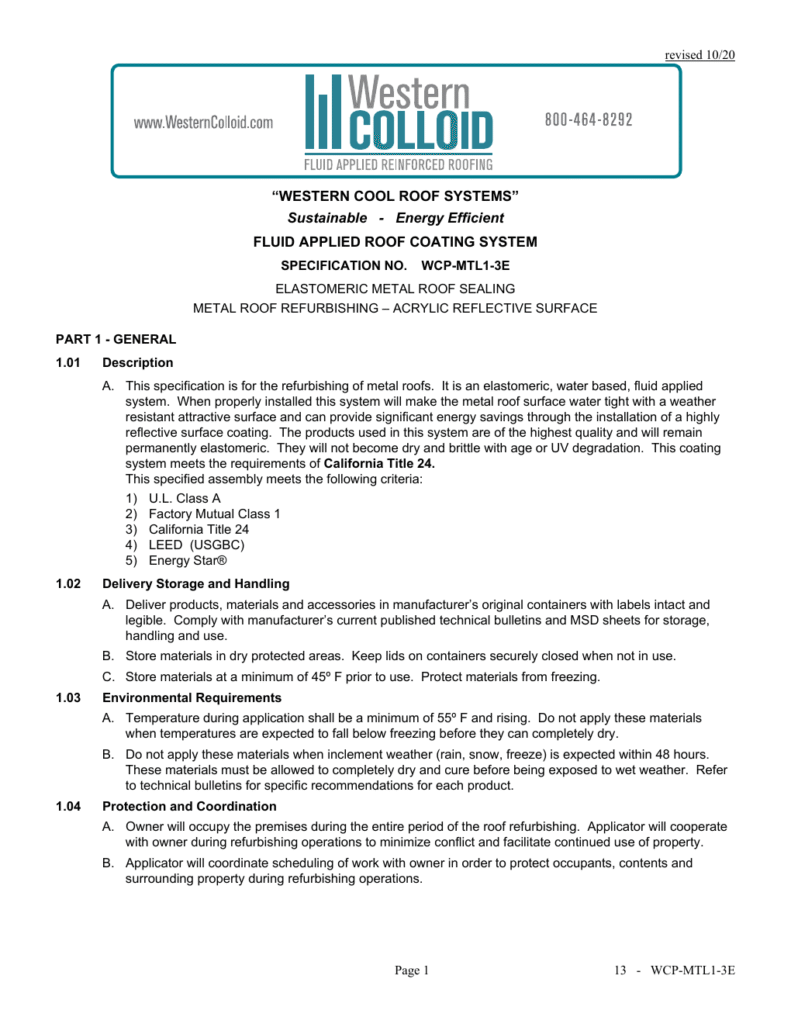
WCP-MTL1-3E is the lighter-coat version of Western Colloid's metal roof refurbishing specification. The number in the code is the ElastaHyde application rate of 3 gallons per 100 square feet, against 4.5 gallons in WCP-MTL1-4.5E. The specification, titled Elastomeric Metal Roof Sealing with an acrylic reflective surface, was revised 10/20 and is part of the Western Cool Roof Systems group.
The system is water based and fluid applied. The coating is elastomeric and is meant to make an existing metal roof surface watertight and reflective. For metal panel roofs within a metal roof restoration scope, it is the two-coat option in the metal series.
Coating rate and thickness
What sets this system apart is the surface coat. ElastaHyde goes on at 3 gallons per 100 square feet in two coats, each about half of the total rate. The average dry thickness after cure is 25 mils.
- Roller, brush or airless spray can apply it.
- Spray application is cross-hatched, with the second coat at a right angle to the first.
- The first coat dries for 24 hours before the second goes on.
- Pooling is avoided, and excess material is brushed out before it dries.
The coating covers about 33 square feet per gallon in the estimating guide. At least 15% is added to the roof area on corrugated metal, and other profiles may need more. By comparison, the 4.5 gallon version is applied in three coats for an average of 36 mils and covers about 22 square feet per gallon.
Data sheets and technical documents
Current manufacturer system specifications, application guidelines and component data sheets matched to this assembly.
Current files
Archived files
No older reviewed revisions are archived for this product yet.
Rating criteria
The assembly is listed as meeting UL Class A, Factory Mutual Class 1, California Title 24, LEED (USGBC) and ENERGY STAR. The ENERGY STAR determination applies to white ElastaHyde only, and color other than white lowers the energy savings.
Seam and flashing materials
Seams and details use #800 Elastic Cement with stitchbonded polyester fabric. The cement is a water-based, permanently elastomeric compound for flashing, sealing and repair. With the fabric, it forms a seal at deck and wall transitions, edges, curbs, pipes, skylights, panel ends, side laps and seams, and it can be applied on vertical surfaces.
The cement bulletin lists a white or black color, 65 to 70% solids by weight, elongation greater than 500%, a tack-free time of 1 hour and a cure time of 1 to 2 days. Its minimum application temperature is 50 degrees F. It is applied by brush or trowel and can be coated after 1 to 2 hours.
Each exposed fastener head is completely covered with the cement. Seams, roof jacks, pipes, metal edges, skylight panels and air conditioning ducts get a three-course seal at 10 square feet per gallon: a coat 5 to 6 inches wide and 1/8 inch thick, a 4 inch polyester strip embedded in it, and a 1/16 inch topcoat. Wider fabric, 6 or 12 inches, handles irregular seams. A single application stays within 3/16 inch.
Preparing the metal
The specification runs through repairs before any coating. Gaps of 1/4 inch or more are closed with self-tapping screws, and voids are covered with sheet metal. Missing fasteners are replaced and loose ones tightened. Replacement fasteners are a larger diameter than the ones removed, and worn washers are swapped for butyl rubber ones.
Loose or peeling coatings and failed repair compounds are scraped or brushed away. The surface is washed with detergent, optionally with a pressure washer, then rinsed and dried. Rust is treated with #900R Rust Primer at up to 1/2 gallon per 100 square feet. Kynar prefinished panels are primed with #900 Metal Bonding Primer at 1/4 to 1/2 gallon per 100 square feet and dry for at least 24 hours. Most other aged and cleaned metal needs no primer.
Where fabric passes over a fastener head, a 1/2 inch straight or X cut lets it lie flat so no void is left under it. Once the cement dries, voids, wrinkles and fishmouths are repaired.
ElastaHyde reflective coating
The surface coat is ElastaHyde #720 ARC or #790 AFC, a 100% acrylic elastomeric coating that meets ASTM D6083/6083M-18. White is standard. For the white #720 ARC, published values are initial solar reflectance of 84% by ASTM C1549, thermal emittance of 89% by ASTM C1371, an SRI of 106, and an aged SRI of 93.
The coating is Class A for fire under UL 790 and ASTM E108. It is listed by the Cool Roof Rating Council under product ID 0682-003 with a weathered solar reflectance of 0.75 and weathered emittance of 0.91. It has solids of 53% by volume and 66% by weight, and passes 1000 hours of xenon arc exposure under ASTM D4798.
Conditions during work
Application temperature must be 55 degrees F and rising. Work stops if temperatures will fall below freezing before the coating dries, or if rain, snow or freeze is expected within 48 hours. Containers are delivered in original packaging with legible labels, stored dry and at 45 degrees F or above, and protected from freezing with lids closed. At the end of the work, the roof and surrounding areas are cleared of debris.
Installing this in San Antonio or Austin?
We install protective coatings for metal roofs and cladding on commercial and industrial buildings from our Bulverde office.
Related products
EverGuard PVC Fleece-Back Membrane
 Illustration
Sikalastic-644 Lo-VOC Fluid-Applied Membrane Roofing
Illustration Sikalastic 641 Lo-VOC Vegetated Protected Membrane Roofing
Illustration Sikalastic-624 WP Fluid-Applied Protected Membrane Roofing
Illustration SMEA-2P-6xE — Acrylic-surfaced reinforced roof system
Illustration SMEA-3P-6xE — Acrylic-surfaced reinforced roof system
Contribution history
Published changes remain in this permanent record. Corrections create a new entry instead of deleting earlier history.
- September 21, 2026 at 8:48 amLibrary Record
WCP-MTL1-3E — Metal roof acrylic restoration system — initial source record
Created the system record and matched the current manufacturer system specification, application guidance and component data sheets.
By Tom · Verified Primary Source
Sources: Official Western Colloid WCP-MTL1-3E — Metal roof acrylic restoration system system page