UltraPly TPO SA
- Manufacturer
- Elevate
- Product
- UltraPly TPO SA
- Status
- Current
- Market
- United States
- Latest file date
- August 25, 2026
- Last verified
- September 20, 2026
Overview
UltraPly TPO SA is a heat-weldable TPO single-ply membrane with Secure Bond Technology, a factory-applied pressure-sensitive adhesive. The membrane is reinforced with a polyester weft-inserted fabric and meets or exceeds ASTM D6878-11 and ASTM D6878M-17 and 19.
It is a self-adhering sheet for fully adhered roof systems. No primers or adhesives are used on horizontal surfaces, so the horizontal installation contains no volatile organic compounds. The technical information sheet is TIS 611, dated August 25, 2026.
Thickness, sizes and item numbers
The sheet is 0.060 inch (1.5 mm) thick, with a thickness tolerance of plus or minus 10 percent. The roll is 10 ft x 100 ft (3.05 m x 30.5 m). Three colors carry item numbers: tan W56TSAT699, gray W56TSAG699 and white W56TSA3699.
The cover edge of each panel is a 2 inch (51 mm) uncoated selvedge used for the heat-welded side lap.
Data sheets and technical documents
Current product files and retained historical revisions.
Current files
Archived files
No older reviewed revisions are archived for this product yet.
Pressure-sensitive adhesive
The adhesive layer is clear. Its properties are listed separately from the membrane.
- Nominal thickness (ASTM E 408-71): 0.008 inch (0.18 mm).
- Weight: 0.4 lbf/ft² (0.20 kg/m²).
- Permeability (ASTM E 96): 0.6 perms.
- Specific gravity (ASTM D 71): 0.93.
A release liner covers the adhesive. Removing it may create a static electric charge.
Typical properties
Typical performance of the 60 mil membrane against the ASTM minimum:
- Breaking strength (D 751 grab method): 390 lbf (1,735 N); minimum 220 lbf (979 N).
- Elongation at reinforcement break: 30 percent; minimum 15 percent.
- Tearing strength (D 751): 156 (694); minimum 55 lbf (245 N).
- Coating over scrim (D 7635): 0.021 inch (0.54 mm); minimum 0.015 inch (0.39 mm).
- Retention after heat aging: more than 90 percent of breaking strength, more than 90 percent of elongation at break, more than 60 percent of tearing strength.
- Water absorption (D 471): less than 1.2 percent.
- Weather resistance (G 155): above 60,000 kJ/m² on an 80 °C black panel with no cracking or crazing around a 3 inch mandrel at 7x.
- Puncture resistance (FTM 101C, Method 2031): 300 lbf (1,334 N).
- Dynamic puncture resistance (D 5635): pass at 40 J in the machine direction and 50 J in the cross direction.
- Static puncture resistance (D 5602): pass at 25 kg.
- Air permeance of the membrane material (E 2178): pass, against a limit of less than 0.004 ft³/ft².
Cool roof and environmental metrics
Cool Roof Rating Council values are initial / 3-year aged.
- For the white SA sheet (rated product ID 0033), initial and aged solar reflectance are 0.74 and 0.59, emittance is 0.84 for both, and SRI is 90 and 69.
- For the light tan (HR) SA sheet (rated product ID 0093), reflectance is 0.76 and 0.67, emittance is 0.90 and 0.91, and SRI is 94 and 82.
- Gray: values are listed as TBD.
White and light tan pass the LEED initial SRI minimum of 85 and the 3-year aged minimum of 64. For Title 24, light tan shows a 3-year aged solar reflectance of 0.67, thermal emittance of 0.91 and SRI of 82. Both white and light tan pass the IgCC 3-year aged SRI minimum of 64 and are listed as Solar Ready and Vegetative Ready. Post-consumer recycled content is 0 percent and post-industrial content is 3 to 5 percent.
Installation sequence
The membrane is installed only when ambient and substrate temperatures exceed 20 °F (-7 °C) and are rising. Insulation is fastened to current Elevate specifications. The sheet is unrolled and allowed to relax in place for at least 30 minutes, longer in colder weather.
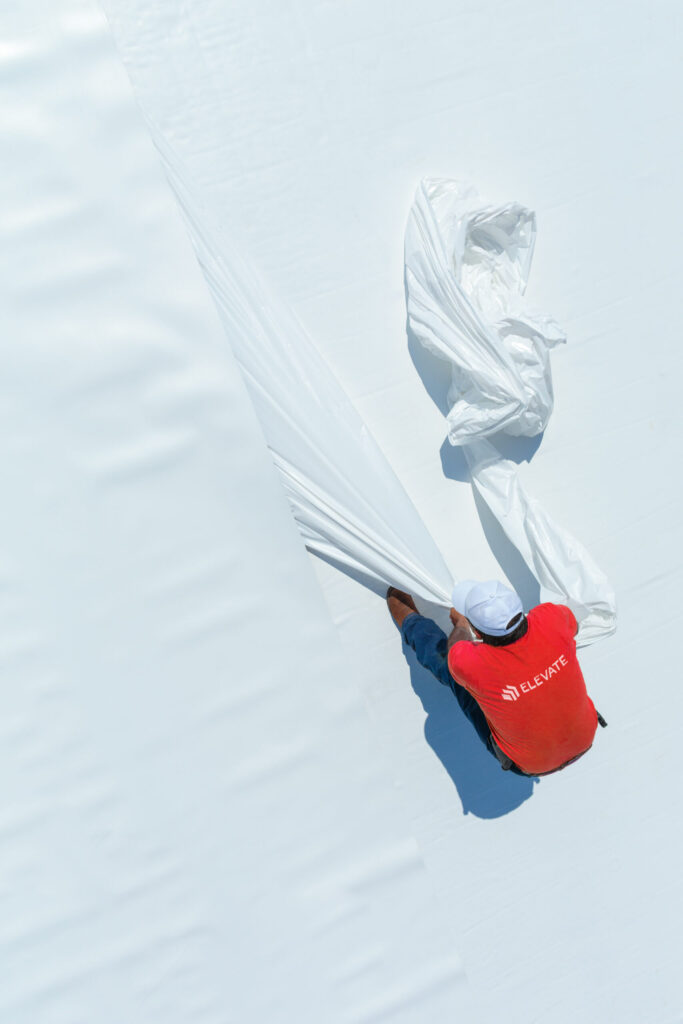
For the field sheet, one end is folded back about 10 ft (3.05 m) and the release liner is removed from the center split at a 45 degree angle, at least 5 ft (1.5 m) first. The liner is then pulled along the full length, up to 100 ft (30.5 m), by two people. The membrane is broomed from the center to the edge with a stiff-bristled broom and rolled with a 5 lb per lineal inch weighted roller. The roller is not used over ISOGARD HD or Resista / ISOGARD CG.
At a roof edge such as a gravel stop or gutter edge, the liner is pulled in two sections, keeping a 12 inch (305 mm) minimum between the liner halves in the direction of travel and a 10 ft (3.05 m) minimum space between the two halves along the edge.
Vertical surfaces receive Single-Ply QuickPrime Primer, Single-Ply LVOC Primer or Elevate Jet Bond Membrane Adhesive before flashing membrane is installed. Jet Bond used as a primer is applied in two overlapping passes at 2,000 square feet (20 square) per canister and left to flash off.
Seaming
Side laps are heat-welded across the 2 inch (51 mm) uncoated selvedge to make a robotic weld at least 1½ inches (38 mm) wide. Because the adhesive runs the full roll length, adjoining rolls are butted at end laps and stripped in with an UltraPly TPO cover strip at least 8 inches (203 mm) wide, centered on the lap and welded along all edges. T-joint patches and UltraPly TPO Cut Edge Sealant complete the detailing.
Acceptable substrates
No primer is listed for ISO 95+ GL / ISOGARD GL, ISOGARD HD, Resista / ISOGARD CG, structural concrete, lightweight concrete, DensDeck Prime, Securock, plywood or OSB board. CMU, masonry and vertical substrates require Elevate Single-Ply or Single-Ply LVOC Primer. The acceptable application temperature is 20 to 120 °F (-7 to 49 °C) for every listed substrate.
Lightweight concrete is accepted only as clean, dry, cured cellular lightweight concrete, not lightweight aggregate concrete. Shelf life is 18 months when stored between 60 °F (16 °C) and 80 °F (27 °C) out of direct sunlight.
Installing this in San Antonio or Austin?
We install TPO roof systems on commercial and industrial buildings from our Bulverde office.
Related products
Acrylic Reinforced Coating System Corrugated Metal Standing Seam R Panel
Duro-Tuff PVC Membrane
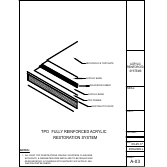
Acrylic Reinforced Coating System TPO
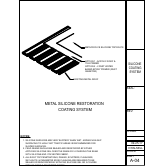
Silicone Roof Coating System Metal Corrugated Standing Seam R Panel
UltraPly TPO Coated Metal