
Silicone Roof Coating System BRAI Torchdown
- Manufacturer
- Metacrylics
- Product
- Silicone Roof Coating System BRAI Torchdown
- Status
- Current
- Market
- United States
- Latest file date
- September 25, 2017
- Last verified
- September 20, 2026
Overview
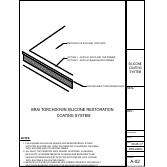
Silicone Roof Coating System BRAI Torchdown is a Metacrylics system assembly for BRAI torch-down modified-bitumen roofing. Metacrylics treats it as a silicone roof coating restoration, with silicone finish coats over the torch-down surface.
The assembly is published as drawing A-02, titled BRAI Torchdown Silicone Restoration Coating System, dated 09-25-17. The drawing shows an existing BRAI torchdown roof beneath Metacrylics silicone topcoats.
Primer and layers
Two primer options are drawn: Option 1 is Acrylic Roof and Tile Primer, and Option 2 is Acrylic Bleed Block Primer.
Drawing note 3 states that Metacrylics Acrylic Bleed Block Primer prevents the asphalt oils from bleeding through the silicone and discoloring it. Note 1 requires field seams to be sealed and reinforced with Silicone Gel over the seam or by 3-coursing with silicone and polyester fabric. Note 2 requires roof top penetrations, drains, scuppers, flashings, skylights and perimeter edge flashing to be sealed or reinforced the same way.
High Solids Silicone is listed for application over BUR modified bitumen, granulated or smooth, and over torch-down roofing. New glazed asphalt and torch-down single-ply assemblies wait 6 months or more before coating. Over modified bitumen, asphalt or coal tar built-up roofing, an appropriate primer is required.
The silicone application book also has a Smooth Surface BUR/Modified Capsheet section with 10-, 15- and 20-year systems, which uses Acrylic Bleed Block Primer at 1 gallon per square (1 SQ = 100 sq. ft.) with 4 to 8 hours to cure.
Data sheets and technical documents
Current manufacturer system specifications, application guidelines and component data sheets matched to this assembly.
Current files
Archived files
No older reviewed revisions are archived for this product yet.
Details on a torchdown roof
Parapet coping is washed or pressure washed first. Rusted areas are primed with a rust inhibitor primer, and Silicone Gel with no reinforcement goes over the top of the coping joints and exposed screws. A 3-course with Acrylic Gel and polyester fabric, or Peel & Coat tape with HS Silicone or Silicone Gel over it, is the alternative.
Plumbing vents get Silicone Gel with no reinforcement a minimum of 3 inches up the vent and onto the roof surface. A 3-course with Acrylic Gel and fabric uses the same 3 inches up and 3 inches onto the roof.
Pitch pockets are filled with HS Silicone or Silicone Gel, then gel goes over and down the pocket and at least 3 inches onto the roof and up the penetration a minimum of 6 inches.
Gutters are pressure washed, and rusted areas must be replaced with new gutters. Rust Inhibitor Acrylic Black Primer is applied at 1 gallon per square, and gel goes over the joints.
Acrylic Bleed Blocker Primer
Metacrylics Acrylic Bleed Blocker Primer is an all-acrylic primer that resists asphalt staining and improves adhesion on asphalt substrates. It provides a water-based way to block bleed-through of asphalt into acrylic and silicone coatings.
It has flexibility at temperatures as low as 0°C (32°F), an ultraviolet barrier for asphalt surfaces, and dirt pick-up resistance. VOC content is 37.5 to 50 g/liter.
Typical values: milky white liquid; total solids by weight 27.5 ±0.5%; pH 9.5 ±0.3; specific gravity 1.05; density 8.76 lbs/US gal; Brookfield viscosity 100–400 cps; Tg -10°C (14°F).
Over unaged asphalt, the minimum coat is 4 dry mil, about 1 gallon per square. Unaged asphalt may need two 8 dry mil coats. Discoloration of the wet coating over aged asphalt is water soluble and disappears after a few rainfalls.
High Solids Silicone topcoat
The coverage rate is 1 gal/100 ft2 (3.78 L/9.29 m2).
Packaging is a 5 gal (18.93 L) pail or a 55 gal (208.2 L) drum.
Elongation is 200% (±15) and tensile strength is 300 psi (±25) by Die C, ASTM D-412.
Hardness measures Shore A 45–55 on the duometer, with a tear strength of 45 lbs/in.
Volatile organic content is 48 g/L (0.40 lbs/gal).
Published reflective values are 88% reflectivity, 91% emissivity and an SRI of 110.
The coating can be sprayed, brushed, rolled or applied with a notched squeegee.
The pump should produce a minimum of 3500 psi at the spray gun head and 3 gallons per minute, with a 5:1 transfer pump feeding it.
The coating is not applied below 40°F (4.4°C) or when precipitation is forecast within 48 hours.
Cure time extends when the coating goes on at temperatures below 40°F (4.4°C).
Spray equipment holding uncured material is flushed with VM&P naphtha or mineral spirits.
Because cure is by reaction with moisture, equipment without moisture lock hoses, fittings and seals can build up cured material on hose walls and unsealed connections.
Silicone Gel
Solids are 94% (±2) by volume and by weight under ASTM D-2697.
The gel meets ASTM D-6694-01, Standard Specification for Liquid-Applied Silicone Coating used in Spray Polyurethane Foam Roofing.
At 75°F and 50% RH the gel is tack free after more than 3 hours and cured in 24 hours.
ASTM D-412 gives 300 psi tensile strength (Die C) and 200% elongation, with Shore A 45–55 hardness and 45 lbs/in tear strength.
The gel is not applied below 40°F (4.4°C) or when precipitation is forecast within 2 hours.
Storage is dry, cool and above 65°F (18°C), with wood pallets rather than concrete floors.
Related products
EverGuard TPO Smooth Membranes
 Illustration
CTG-3xE — Acrylic-surfaced reinforced roof system
Illustration Sikalastic-835 I – 701 SF Fluid-Applied Protected or Exposed Membrane Roofing-Waterproofing
Duro-Last EV PVC Membrane
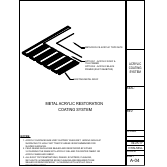
Acrylic Roof Restoration Coating System Metal Corrugated Standing Seam R Panel
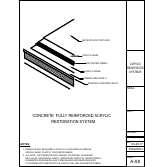
Acrylic Reinforced Coating System Concrete
Contribution history
Published changes remain in this permanent record. Corrections create a new entry instead of deleting earlier history.
- September 21, 2026 at 8:48 amLibrary Record
Silicone Roof Coating System BRAI Torchdown — initial source record
Created the system record and matched the current manufacturer system specification, application guidance and component data sheets.
By Tom · Verified Primary Source
Sources: Official Metacrylics Silicone Roof Coating System BRAI Torchdown system page