
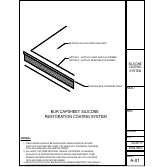
Silicone Roof Coating System BUR Capsheet
- Manufacturer
- Metacrylics
- Product
- Silicone Roof Coating System BUR Capsheet
- Status
- Current
- Market
- United States
- Latest file date
- September 25, 2017
- Last verified
- September 20, 2026
Overview
Silicone Roof Coating System BUR Capsheet is a Metacrylics system assembly for built-up roofing with a cap sheet. The assembly applies a silicone roof coating over existing cap sheet roofing, using silicone finish coats.
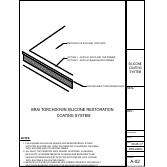
The assembly is published as drawing A-01, titled BUR Capsheet Silicone Restoration Coating System, dated 09-25-17. It is the first sheet in the A-01 to A-09 numbering of the silicone restoration drawings.
Primer and layers
The drawing shows an existing BUR capsheet roof with two primer options: Option 1 is Acrylic Roof and Tile Primer, and Option 2 is Acrylic Bleed Block Primer. Metacrylics silicone topcoats follow.
The third drawing note states that Metacrylics Acrylic Bleed Block Primer prevents the asphalt oils from bleeding through the silicone and discoloring it. The first two notes require field seams to be sealed and reinforced with Silicone Gel or a 3-course of silicone and polyester fabric, and require penetrations, drains, scuppers, flashings, skylights and perimeter edge flashing to be sealed or reinforced in the same way.
The silicone application book gives smooth surface BUR and modified capsheet systems as 10-, 15- and 20-year systems. In each, the roof is pressure washed, Acrylic Bleed Block Primer is applied at 1 gallon per square (1 SQ = 100 sq. ft.) with 4 to 8 hours to cure, and penetration details follow the primer.
- 10-year system: 2 gallons per square of HS Silicone White, in one pass. Vertical surfaces take 2 coats at 1 gallon per square per coat, with 24 hours between applications.
- 15-year system: 2.5 gallons per square, in one pass, with vertical surfaces handled in 2 coats at 1 gallon per square per coat.
- 20-year system: 3 gallons per square in two applications of 1.5 gallons per square, with 24 hours to cure between applications.
Bad seams are reinforced with polyester fabric and either HS Silicone White or Silicone Gel in all three.
Data sheets and technical documents
Current manufacturer system specifications, application guidelines and component data sheets matched to this assembly.
Current files
Archived files
No older reviewed revisions are archived for this product yet.
Details on a capsheet roof
For nosings, edge flashings and gravel stops, primer goes on all edge flashings and new metal is wiped with vinegar or a suitable cleaning agent. The gel without fabric, or a 3-course with Acrylic Gel and 4 inch or 6 inch fabric, is applied 2 to 3 inches onto the flashing and 2 to 3 inches onto the roofing surface.
For wood blocks, the block is lifted and removed, Silicone Gel is applied to the area where it sat, and the block is replaced after drying. If the roof is damaged while a block is removed, gel with no reinforcement or a 3-course is used.
Wood sleepers that support HVAC units are removed by jacking up the unit, and HS Silicone goes on at 2 gallons per square where the sleeper sat. The lags attaching the HVAC unit to the sleepers must not be long enough to penetrate the roof system.
Acrylic Bleed Blocker Primer
Metacrylics Acrylic Bleed Blocker Primer is an all-acrylic primer for resistance to asphalt staining and for adhesion to the roof substrate. It is intended for use over asphalt substrates, which can bleed through acrylic and silicone coatings.
Over aged built-up asphalt, modified bitumen, metal, concrete and other substrates it gives adhesion, and it acts as a barrier to ultraviolet light, which degrades the surfaces of asphalt materials. It has flexibility at temperatures as low as 0°C (32°F), is applied by spray, brush or roller, and has a VOC content of 37.5 to 50 g/liter. Cleanup is with soap and water.
Typical values: milky white liquid, total solids by weight (ASTM D-2369) of 27.5 ±0.5%, pH 9.5 ±0.3, specific gravity 1.05, density 8.76 lbs/US gal, Tg (DSC) of -10°C (14°F), Brookfield viscosity of 100–400 cps. Storage stability is unchanged at 10 days at 60°C, and the product is protected from freezing.
Over unaged asphalt, the minimum is 4 dry mil, about 1 gallon per square, and two 8 dry mil coats may be needed. The wet coating can discolor right away over aged asphalt, and the water-soluble discoloration disappears after a few rainfalls.
It is not applied below 5°C (40°F), at humidity above 90%, when rain is expected, or when temperatures are expected to fall below the dew point within 6 hours.
High Solids Silicone topcoat
It is packaged in a 5 gal (18.93 L) pail or a 55 gal (208.2 L) drum.
White, light gray and tan are the standard colors, and custom colors are made on request with 15 additional days for non-standard colors.
Duometer hardness is Shore A 45–55, and tear strength is 45 lbs/in.
The film measures 2.0 U.S. perms, and ASTM D-570 water absorption is 0.2.
Reflectivity is 88%, emissivity is 91% and SRI is 110.
It is not recommended for continuous immersion service, for cryogenic tanks, or for cold storage roofing without a vapor barrier.
Spray equipment is a high-pressure airless pump producing at least 3500 psi at the gun head and at least 3 gallons per minute, fed by a 5:1 transfer pump to prevent cavitation.
Hoses need a BUNA-N jacket and a minimum I.D. of 3/4 inch.
It can be applied at lower temperatures, but the cure time is extended.
Before any surface is coated, an adhesion test to ASTM D-903 checks that the coating will adhere.
The coating cures by reacting with moisture, so uncured material is not left in guns, pumps or hoses for long periods unless the equipment has moisture lock hoses, fittings and seals.
Recoating of existing spray-in-place roofing systems is permitted over a cleaned and completely dry surface.
Silicone Gel
Tested material complies with ASTM D-6694-01, the standard specification for liquid-applied silicone coating used in spray polyurethane foam roofing.
Packaging is a 2 gallon or 3.5 gallon bucket, and the color is white.
Hardness is Shore A 45–55, tear strength is 45 lbs/in, tensile strength is 300 psi (Die C, ASTM D-412) and elongation is 200%.
No degradation appears after 5,000 hours of QUV weathering, and the gel measures 7.9 U.S. perms.
Containers are kept closed in a dry, cool place above 65°F (18°C), on wood pallets rather than concrete floors.
Spot repairs, reinforcement of seams, flashings and penetrations, and sealing of solar and air conditioning joint and penetration repairs are the typical uses.
Related products
Contribution history
Published changes remain in this permanent record. Corrections create a new entry instead of deleting earlier history.
- September 21, 2026 at 8:48 amLibrary Record
Silicone Roof Coating System BUR Capsheet — initial source record
Created the system record and matched the current manufacturer system specification, application guidance and component data sheets.
By Tom · Verified Primary Source
Sources: Official Metacrylics Silicone Roof Coating System BUR Capsheet system page