
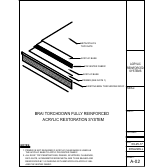
Acrylic Reinforced Coating System BRAI Torchdown
- Manufacturer
- Metacrylics
- Product
- Acrylic Reinforced Coating System BRAI Torchdown
- Status
- Current
- Market
- United States
- Last verified
- September 20, 2026
Overview
Acrylic Reinforced Coating System BRAI Torchdown is a Metacrylics assembly for BRAI torch-down modified-bitumen roofing. The drawing is sheet A-02, titled BRAI Torchdown Fully Reinforced Acrylic Restoration System, dated 09-25-17. The finish chemistry is acrylic.
System layers
The drawing shows, from the existing BRAI torch-down roof upward, a primer, an acrylic base coat, polyester fabric, a second acrylic base coat and Metacrylics topcoats. Note 1 on the sheet makes the primer unnecessary where Acrylic Clear Base is the acrylic base that carries the polyester fabric. Note 2 states that penetrations, drains, scuppers, flashings, skylights and perimeter edge metal are sealed and reinforced by 3-coursing with Acrylic Gel and polyester fabric.
New glazed asphalt and torch-down single-ply assemblies wait 6 months or more before application.
Data sheets and technical documents
Current manufacturer system specifications, application guidelines and component data sheets matched to this assembly.
Current files
Archived files
No older reviewed revisions are archived for this product yet.
Bleed Blocker Primer properties
Acrylic Bleed Blocker Primer is the primer data sheet for this system. Typical properties:
- Appearance: milky white liquid
- Total solids by weight, ASTM D-2369: 27.5 plus or minus 0.5 percent
- pH as packed: 9.5 plus or minus 0.3
- Specific gravity 1.05; density 8.76 lbs per US gallon
- Tg (DSC): minus 10 degrees C, 14 degrees F
- Viscosity (Brookfield): 100 to 400 cps
- Storage stability: unchanged at 10 days at 60 degrees C
- VOC: 37.5 to 50 g per liter
Listed benefits include adhesion over aged built-up asphalt, modified bitumen, metal and concrete; a barrier to ultraviolet light; resistance to asphalt staining; dirt pick-up resistance; and flexibility at temperatures as low as 0 degrees C (32 degrees F).
The primer is not applied below 5 degrees C (40 degrees F), at relative humidity above 90 percent or when rain is expected, or when temperatures can be expected to fall below the dew point within the next 6 hours. It is protected from freezing in storage.
Base coat
Acrylic Gray Base is a gray water-based acrylic elastomeric coating with a solids content of 67.9 percent by weight, a weight of 12.1 pounds per gallon and a VOC of 11.73 grams per liter. Tensile strength is 156 psi at 81 mils including the 10 mil fabric. Strength at break is 1,914 psi at 74 degrees F and 3,540 psi at 0 degrees F. Elongation is 149 percent average.
It is sprayed with a .061 tip at 2 to 3 gallons per 100 sq. ft., then fabric, then 2 gallons per 100 sq. ft. over the fabric. The coating is protected from ultraviolet light by an Acrylic White or color coat.
Clear base, gel and topcoat
Acrylic Clear Base is transparent and water-based, and is used as a self-priming basecoat or primer. Acrylic Gel is white, gray or clear and is used for flashing and fabric reinforcement; its low temperature flexibility is a pass at 1 inch and minus 40 degrees F by ASTM C836. Extreme Performance Plus Acrylic White has a flash point above 200 degrees F by ASTM 1310 and a low temperature flexibility pass at minus 40 degrees F.
T326 is a stitchbonded polyester with a firm finish. Its tensile value is 41 lbs, its weight 2.75 oz/yd2 and its Mullen burst 127 lbs. T272 has a tensile of 57.1 lbs.
Silicone alternative and roof conditions
The manufacturer's BUR and modified bitumen page also lists a silicone path: Roof & Tile Primer or Bleed Blocker Primer, Silicone Gel at details and High Solids Silicone. The listed concerns on asphalt roofs are asphalt oil bleed-through and discoloration; blisters, open laps, splits and loose granules; and alligatoring around details and transitions. Preparation steps are to repair blisters, splits and loose laps, clean and dry the asphaltic surface and use Bleed Blocker before base or top coats. The release checkpoints are an acceptable moisture survey, repairs that are flush and reinforced, and a continuous bleed-blocking film.
Clear Base properties
Acrylic Clear Base is white as a liquid and dries clear and tacky. It must be protected from sunlight with a Metacrylics acrylic topcoat. It is used as a self-priming basecoat or as a primer for adhesion to existing surfaces, and for exterior and below-grade waterproofing. Tensile strength is 276 psi at 81 mils including 10 mil fabric, elongation is 434 percent average, hardness is Shore A 41 and there is no flash at 200 degrees F. Chemical resistance shows no effect from 1 percent sodium hydroxide, with some softening and spotting from gasoline and some spotting from lubricating oil.
Gel approvals and reflectance
Acrylic Gel is a water-based elastomeric mastic that is non-volatile, UV resistant and listed as Title 24 compliant. CRRC testing C-1371 gives solar reflectance 0.87 and thermal emittance 0.90 under Seller ID 0660. It carries ICC-ES Report No. 4785 and a UL Classified Class A fire and wind uplift rating, and its temperature cycling and penetration test passed 25 continuous cycles with a thickness change of less than 1 percent. Acrylic Gel, Acrylic Clear Base and the other Metacrylics products contain no zinc oxide.
Fabric properties
The Stitchbond polyester fabric is made in four grades. Average typical properties, with trapezoid tear by ASTM D 1117:
- T272: tensile 57.1 lbs, elongation 61.65 percent, Mullen burst 176.8 lbs, trapezoid 16.1 lbs
- T325: 3 oz/yd2, tensile 31.6 lbs, elongation 40.6 percent, Mullen burst 99.6 lbs, trapezoid 13.2 lbs
- T326: 2.9 oz/yd2, tensile 41 lbs, elongation 25.8 percent, Mullen burst 127 lbs, trapezoid 14.2 lbs
- W201: 2.75 oz/yd2, tensile 75 lbs, elongation 42.9 percent, Mullen burst 150 lbs, trapezoid 13.4 lbs
Penetration and edge details
Pages 49 and 50 of the spec book set out detail sequences for roof features. Scuppers take gel inside and outside, with a 9 to 20 inch square of fabric embedded at least 4 inches into the scupper and a gel cover coat. Skylights get a 3-course up the curb at least 3 inches and 3 inches onto the field, gel on exposed screw heads and no covering over the weep holes. Edge flashings, nosings and gravel stops are primed and given a 3-course of 6 to 9 inch fabric and gel, 3 inches onto horizontal flashing and 3 inches onto the vertical outside wall.
Modified bitumen context
The assembly is a coating system for roofs of the type covered under modified bitumen roofing. On the manufacturer's website, the nearest listed system is BUR and modified cap sheet, with layers of Acrylic Clear Base or specified primer, polyester fabric, acrylic base coat and acrylic top coat.
Related products
 Illustration
Sikalastic 621 TC Fluid Applied Skylight Waterproofing
EverGuard TPO Smooth Membranes
Illustration CTG-3xE — Acrylic-surfaced reinforced roof system
Illustration Sikalastic-835 I – 701 SF Fluid-Applied Protected or Exposed Membrane Roofing-Waterproofing
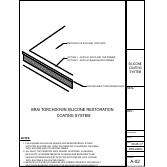
Silicone Roof Coating System BRAI Torchdown
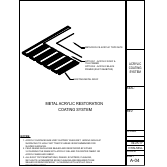
Acrylic Roof Restoration Coating System Metal Corrugated Standing Seam R Panel
Contribution history
Published changes remain in this permanent record. Corrections create a new entry instead of deleting earlier history.
- September 21, 2026 at 8:48 amLibrary Record
Acrylic Reinforced Coating System BRAI Torchdown — initial source record
Created the system record and matched the current manufacturer system specification, application guidance and component data sheets.
By Tom · Verified Primary Source
Sources: Official Metacrylics Acrylic Reinforced Coating System BRAI Torchdown system page