Isocindu Isocop Roof Panel
- Manufacturer
- Isocindu
- Product
- Isocindu Isocop Roof Panel
- Status
- Current
- Market
- United States
- Latest file date
- February 22, 2025
- Last verified
- October 15, 2026
What Isocop 4 is and where it is used
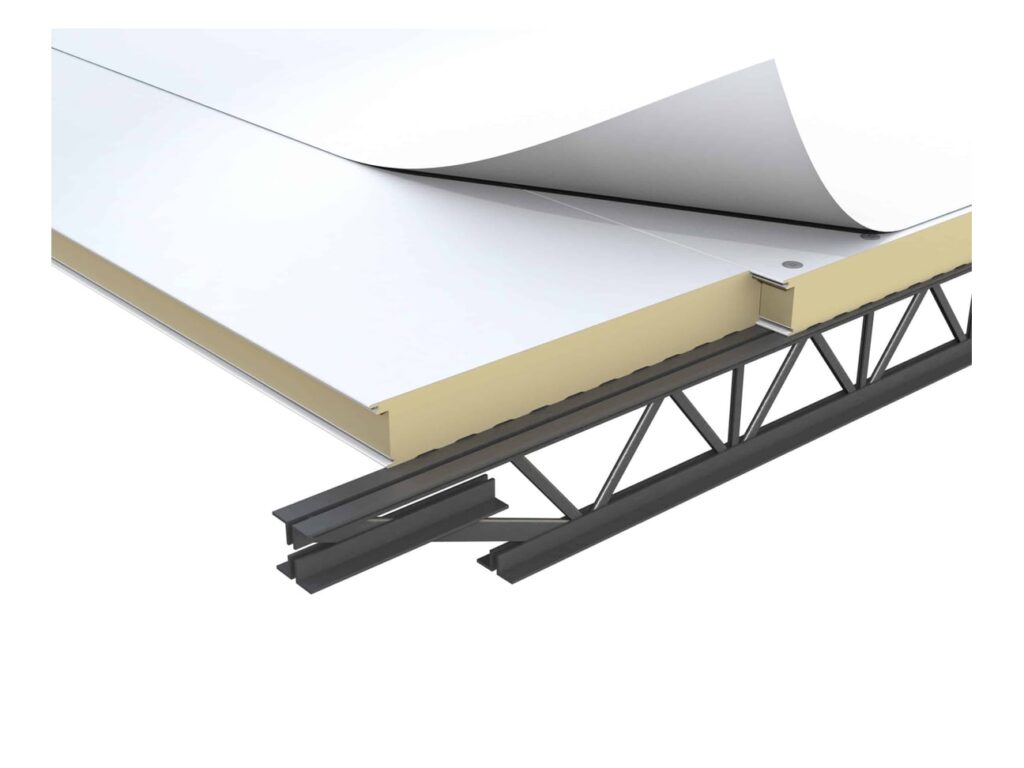
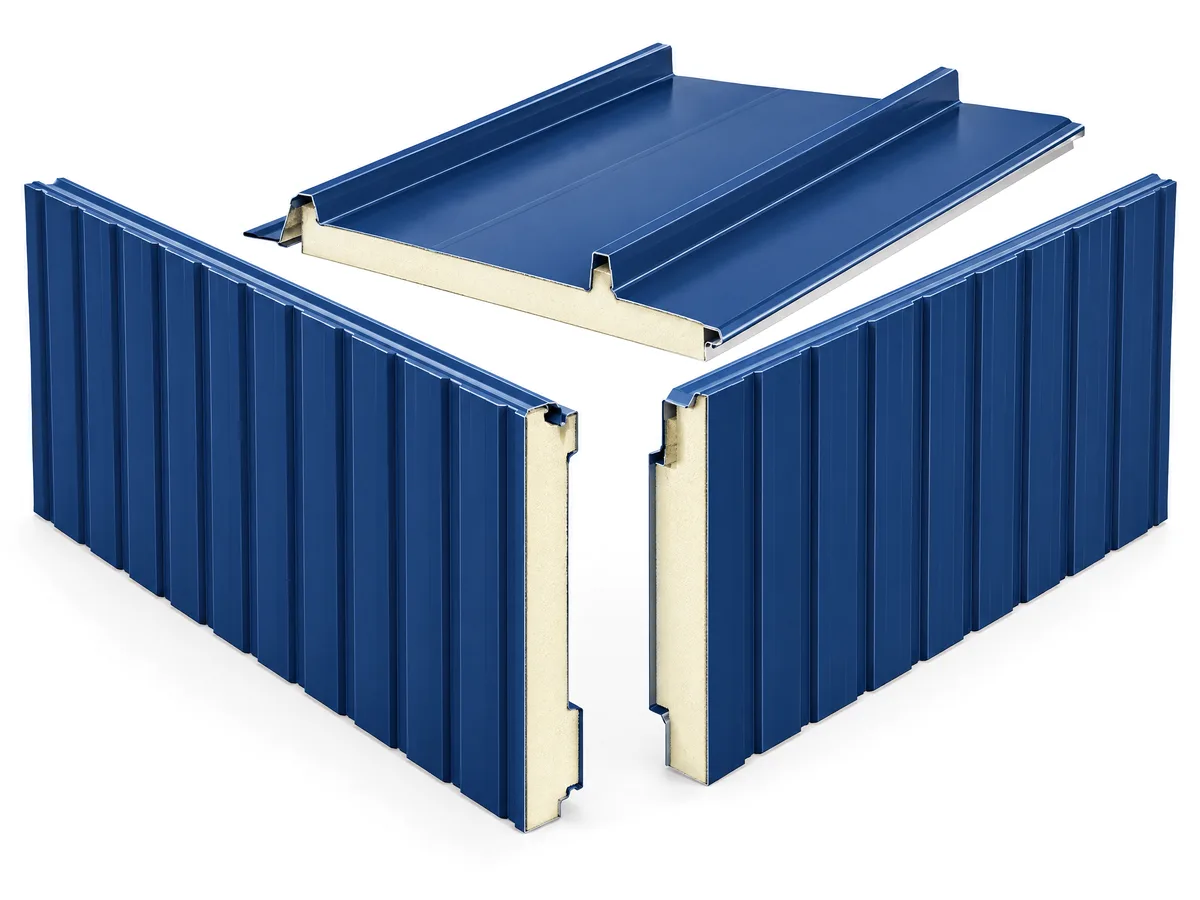
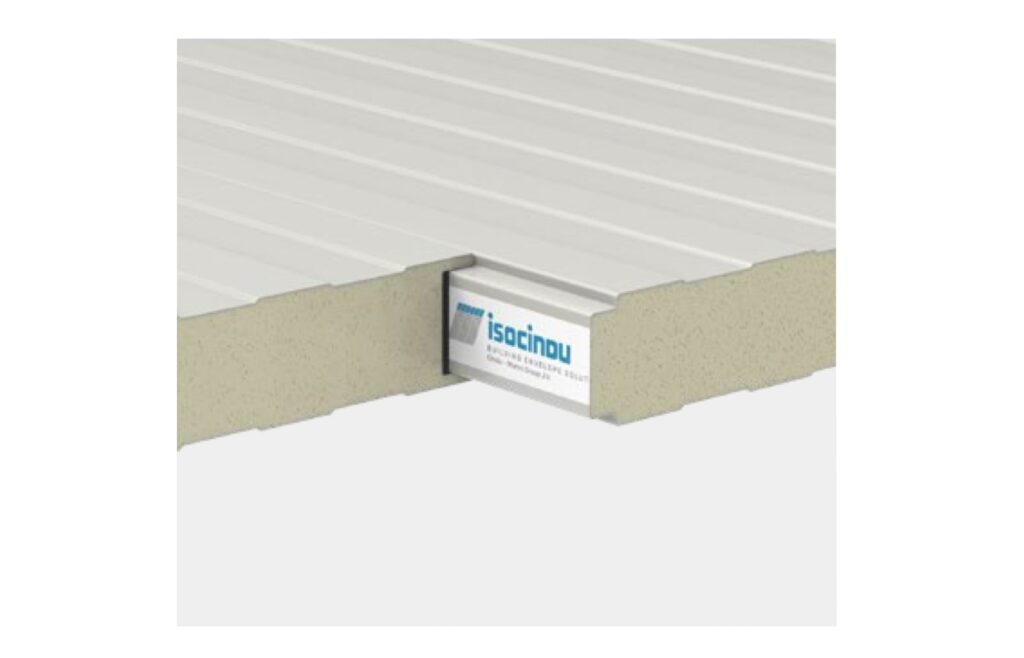
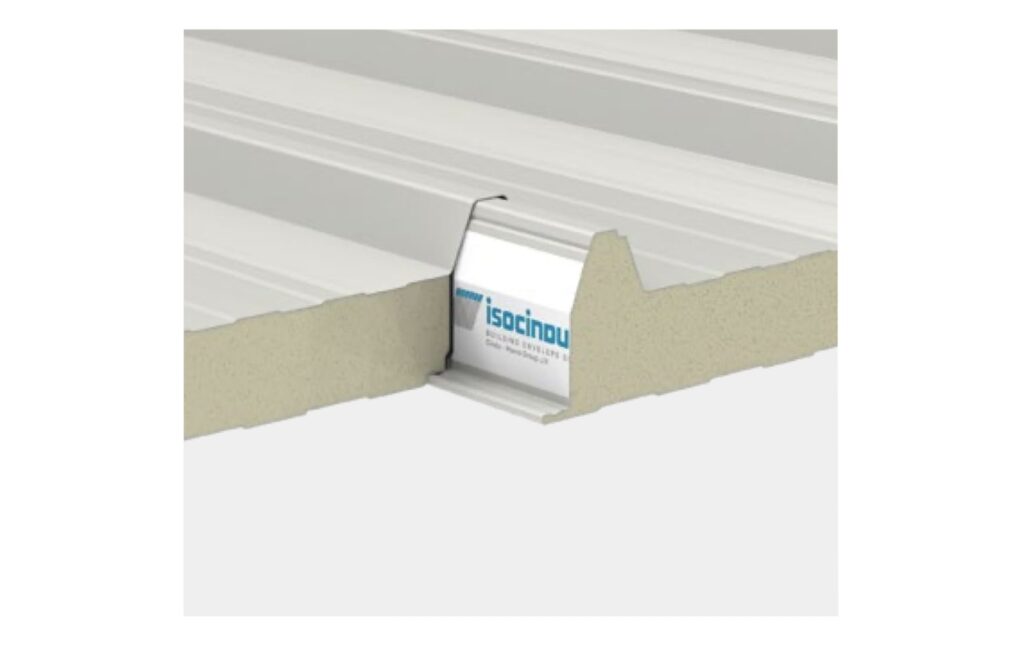
Isocop 4 is a double-steel sheet roof panel insulated with rigid foam. The panel is made by Isocindu. The exterior face carries 4 trapezoidal rows that add strength under static and dynamic forces. The exposed fastening system includes saddle clips and cap ribs for concealed fastening and weather tightness. The panel works with several roofing sub-structures.
Isocop 4 serves industrial, warehouse, zootechnical and residential construction. It is used on new construction and on roof refurbishing. The same panel can also clad walls. These panels are a type of insulated metal panel roofs and walls.
Isocop 4 is a structural roof panel. It is used where Type V-B construction (combustible, nonfire-resistance-rated) is permitted by the International Building Code. Division 07 00 00 covers thermal and moisture protection, and Section 07 40 00 covers roofing and siding panels.
Versions and sizes
Every Isocop 4 panel has a nominal width of 39 ⅜”. The side joint is a tongue and groove, and it is exposed. Panels run vertically or horizontally. Overlapping is available. The minimum panel length is 8'-0”.
Nominal thicknesses:
- 1”
- 1½”
- 2”
- 2½”
- 3”
- 4”
- 5”
- 6”
- 8”
The exterior and interior faces are flat or embossed. Four core types are made: PUR, PIR, PIR R+ and Leaf. Isocop 4 is FM certified only in thicknesses from 1½” to 6”. The evaluation report covers 2” to 8” panels with PIR foam.
Dimensional tolerances:
- Length up to 9' 10”: ± ⅛”
- Length over 9' 10”: ± ⅜”
- Working length: ± 1/16”
- Perpendicularity deviation: ¼”
- Misalignment of the internal metal surfaces: ± ⅛”
- Bottom sheet coupling: 1 + ⅛”
Data sheets and technical documents
Current files
Archived files
No older reviewed revisions are archived for this product yet.
Materials, coatings and colors
The faces are galvanized steel sheet. The core is rigid foam that is foamed in place between the two sheets. A PIR core has a flame-spread index of 25 or less and a smoke-developed index of 450 or less, tested to ASTM E84 at 4 inches.
The standard coating is polyester G60. Kynar G90 is the alternate coating. The standard coating is USDA approved, and USDA approved finishes are made in all the standard white colors for food processing and storage. The Kynar system is a polyvinyl coating that contains 70% Kynar or Hylar resins. Other paint systems are available on demand.
Standard colors:
- Pure White RAL 9010
- White Gray RAL 9002
- Signal White RAL 9003
- Silver Gray RAL 9006
- Anthracite Gray RAL 7016
White colors give lower surface temperatures and reduced thermal expansion. Dark colors absorb more heat and increase thermal movement. Red, brown and green colors fall in the dark group. Coatings are chosen for the expected range of thermal movement, because temperature changes cause dimensional change in the panel surface.
The joint gasket is open cell. Butyl is available on request and can be placed in the plant. The gasket forms a barrier against vapor leaks.
Fasteners, clips and sealant
Roof saddle clips are No. 16 gauge steel to ASTM A653 SS Grade 37 with a Class G90 galvanized coating. The clips are color-matched to the panels with PVDF coating finishes. Isocindu's saddle fastening is mandatory.
Panel fasteners need a minimum head diameter of 5/8”, a minimum thread diameter of 1/4” and corrosion resistance. Flashing is No. 26 gauge and corrosion resistant. Panel joints and trim take non-skinning butyl sealant. The sealant is applied to clean, dry surfaces at temperatures from 40°F to 120°F. During erection the side joints interlock so that the butyl sealant stays in continuous contact with the adjacent panel.
Two joint systems are used:
- Roof clip: a concealed clip with a clean appearance and allowance for thermal movement.
- Cap rib: a cap fitted over the clip, with higher uplift resistance.
Both systems give weather tightness when installed with sealant.
Installation details and handling
On the roof-clip joint, a ¼-14 hex washer head fastener with washer is set at 12” o.c. A continuous butyl sealant is installed in the panel joint in the field. The endlap has a longitudinal gasket and butyl sealant tape, and the lap measures 10”. Corner trim for the wall and roof external joint is fixed with pop rivets at 8” o.c. Inside corner trim is field-filled with compressible insulation that Isocindu does not supply.
The number of fastenings depends on the local climatic zone. The normal fastening density is one fastener on alternating ribs at central beams and one on every rib at terminal beams. Installation proceeds in one direction along the roof, with the wind direction marked on the joint.
Panels in storage:
- Place the panels on flat supports spaced evenly, every 4 ft 11” to 6 ft 6 ¾” at most.
- Tilt the stack slightly to one side, 2° to 5°, so water drains if it is stored outdoors.
- Cover the panels with breathable waterproof material to prevent condensation.
Handling practice:
- Use padded lifting gear.
- Store panels off the ground.
- Protect panel faces and joints at all stages.
- Plan the installation sequence to limit re-handling.
- Use at least 2 to 3 workers when handling manually.
Forklifts lift one bundle at a time with the forks as far apart as possible. Longer panels flex more at the center, so long forks reduce bending. A bundle that sags is lifted with spreaders under the pack or on a rigid pallet. Spreaders are wooden boards, typically 4”x4” or wider, longer than the panel width. Each pack takes a minimum of 3 spreaders.
Thermal values and spans
PIR R+ panels carry these R-values (h ft² F/Btu) at 75° F mean temperature (95° to 55°), tested to ASTM C518:
- 1”: 7.5
- 1½”: 11.3
- 2”: 15.1
- 2½”: 18.8
- 3”: 22.6
- 4”: 30.1
- 5”: 37.7
- 6”: 44.9
- 8”: 60.4
At 35° F mean temperature (55° to 15°) the R-values are 8.4 at 1”, 12.4 at 1½”, 16.8 at 2”, 20.8 at 2½”, 25.2 at 3”, 33.7 at 4”, 42.1 at 5”, 50.5 at 6” and 67.4 at 8”. The U-value at 75° F falls from 0.13 Btu/h ft² F at 1” to 0.01 at 8”.
Span between two simple supports, 26/26 gauge with PIR core and a 10% safety factor, at 16 PSF: 9'-2” at 1”, 10'-5” at 1½”, 12'-1” at 2”, 13'-5” at 2½”, 16'-4” at 3”, 18'-6” at 4”, 19'-6” at 5”, 20'-2” at 6” and 20'-9” at 8”. At 51 PSF the span is 3'-9” at 1” and 12'-7” at 8”. Spans use a maximum deflection of L/180, leave out fasteners, and exclude the temperature differential. The chart does not apply to ceilings.
Fire, wind and hail ratings
Isocop is approved by FM to Class 1 for panel roofs, with a PIR core from 1.5 to 6 in thick and a width of 39.4 in. The panel is rated for severe hail, a wind uplift of 105, external fire A and internal fire 1.
The securement for the panel roof has one fastener and saddle washer at each high rib along the supports, every 13 in on center. Laps are stitch fastened at a maximum of 24 in o.c. between supports.
FM also lists Isocop for Class 1 fire rating of insulated wall and roof or ceiling panels, and for Class 1 exterior wall systems. The exterior wall listing gives a wind pressure rating of +105/-105 in Zone TC and a severe hail rating. The minimum panel length is 8 ft and the minimum exterior thickness is 0.016 in.
An Environmental Product Declaration under the International EPD System covers Isocop 4 and is valid to 04/12/2028.
What each version is for
Each build suits a set of buildings:
- Industrial: warehouses, factories and distribution centers.
- Cold chain: cold chambers and food processing.
- Commercial: offices, retail and convention centers.
- Architectural: schools, museums and government buildings.
- Specialized: airports, green building and grain sheds.
Thicker panels from 4” to 8” give the highest R-values and the longest spans. Thin panels of 1” and 1½” cover short spans. The USDA approved finish fits food processing and storage. White colors fit roofs where lower surface temperature matters. The cap rib joint fits roofs that need higher uplift resistance, and the roof clip joint fits roofs that need a clean appearance and room for thermal movement.
The panel resists rust, mold and humidity. It has high mechanical strength, and the surface washes clean.