
7.2 Panel
- Manufacturer
- PAC-CLAD | Petersen
- Product
- 7.2 Panel
- Status
- Current
- Market
- United States
- Last verified
- September 7, 2026
Overview
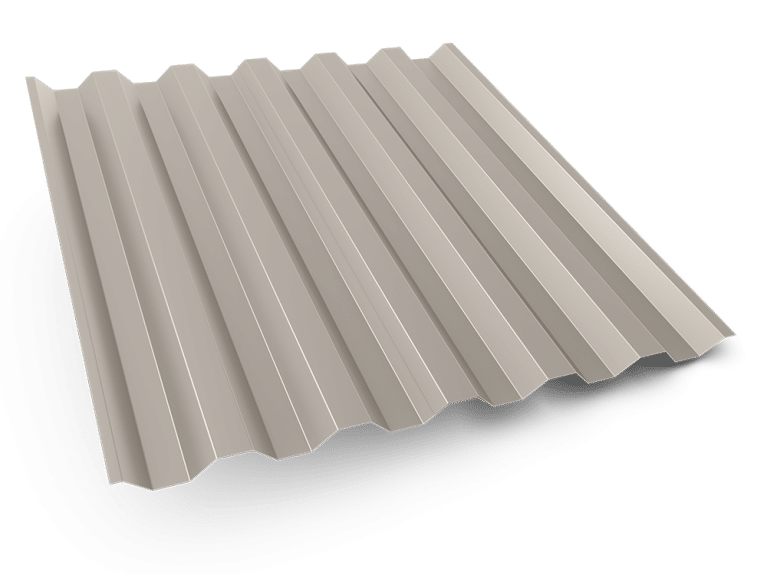
The 7.2 Panel is a deeper-ribbed profile in the PAC-CLAD | Petersen exposed-fastener range. Its name comes from its rib spacing of 7.2 inches. It is used on roofs and walls as one of the exposed-fastener metal roof panels.
Profile and dimensions
The panel is 36 inches wide (nominal) and 1-1/2 inches high. Ribs are 1-1/2 inches high at 7.2 inches on center, with crests 2 inches wide and valleys 2 inches wide. Installed coverage is 36 inches for both roofing and wall use.
- Width: 36 in. nominal
- Rib height: 1-1/2 in.
- Rib spacing: 7.2 in. on center
- Crest and valley width: 2 in. each
Materials
Available in .032, .040 and .050 aluminum, and 24 or 22 gauge steel. Galvalume Plus is an option. Precut lengths start at 5 feet, and maximum lengths are 30 feet in steel and 22 feet in aluminum.
Data sheets and technical documents
Current product files and retained historical revisions.
Current files
Archived files
No older reviewed revisions are archived for this product yet.
Tests and approvals
The panel is tested under ICC ES-5839. Florida Building Product Approvals for exposed-fastener panels apply. The 7.2 panel is made at the Tyler, TX factory in addition to other plants.
Finish and accessories
The finish is a Kynar 500 or Hylar 5000 fluorocarbon with a 35-year non-prorated warranty. Matching screws and rivets and closure strips are available.
Fastening and trim
The 7.2 Panel is a lappable, structural ribbed panel that is fastened directly to the substrate and has an overlapping sidelap. Fasteners use combination steel and EPDM washers and penetrate the girt or purlin by 1 inch. Sidelap and flashing screws are #14 HHA x 3/4 inch sheet metal stitch screws at 12 inch centers. Closures are pre-molded polyethylene to suit the rib shape. Trim is press-broken in 10 to 12 foot lengths with factory-welded miters.
The coating has a topside film of 0.70 to 0.90 mil over a 0.25 to 0.3 mil prime coat, and a 0.25 mil underside primer, meeting AAMA 621.
Perforated version
The 7.2 Panel is also covered by the perforated exposed-fastener guide specification, in .032, .040 and .050 aluminum painted one side. Round hole patterns run from 1/8 inch holes on .324 inch staggered centers (13.5 percent open area) to 3/8 inch holes on 9/16 inch centers (40 percent open area). Perforated panels carry a 20-year finish warranty period and a longer lead time.
Test reports and load data
- ASTM E1592 test reports: .050 aluminum at 1, 5 and 7 to 10 foot spans, .032 aluminum and 24 gauge steel
- Additional reports: ASTM E1680 and E1646, E283 and E331
- Evaluation report: ICC-ES ESR-5839
- Florida approvals: roofing (non-HVHZ), siding and wall panels
- Load tables: negative load for .032 aluminum, .050 aluminum and 24 gauge steel; long-span .050 equipment screen; perforated .050 load-span charts
The .050 aluminum is tested for spans up to and including 10 feet.
Applications and details
The panel is specified for roofs, walls and linear panels. Z-girt detail drawings cover inside and outside corners, installation, jamb, sill, top of wall, top of wall tie-in, wall-to-soffit, and window head, jamb and sill conditions, horizontally and vertically. Trim and flashing are PAC-CLAD aluminum from .032 to .063 or steel in 24 or 22 gauge. Vinyl strippable masking is recommended where extra handling is expected and is removed immediately after installation.
Installing this in San Antonio or Austin?
We install R-panel roofs and wall cladding on commercial and industrial buildings from our Bulverde office.
Related products
Contribution history
Published changes remain in this permanent record. Corrections create a new entry instead of deleting earlier history.
- September 7, 2026 at 2:41 pmLibrary Record
Technical Library first verified catalogue capture
First verified capture of the current official product page. Website record update only; not evidence of product launch or manufacturer change.
By TCR editorial team · Verified Primary Source