Swisspearl Construction
- Manufacturer
- Swisspearl
- Product
- Swisspearl Construction
- Status
- Current
- Market
- United States
- Last verified
- September 23, 2026
Overview
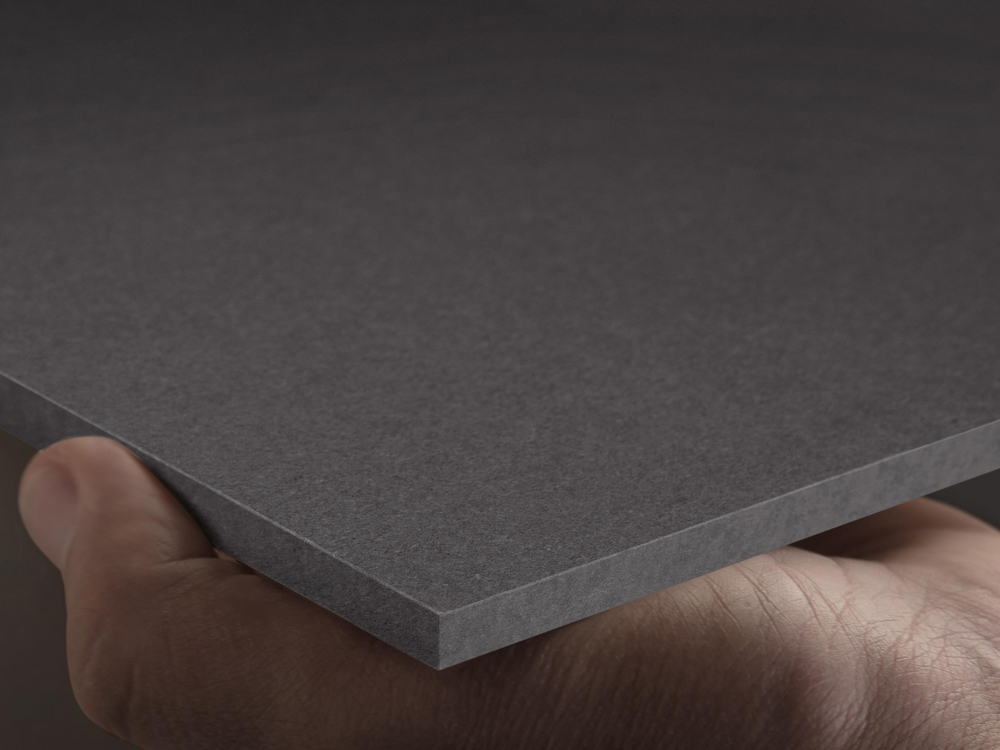
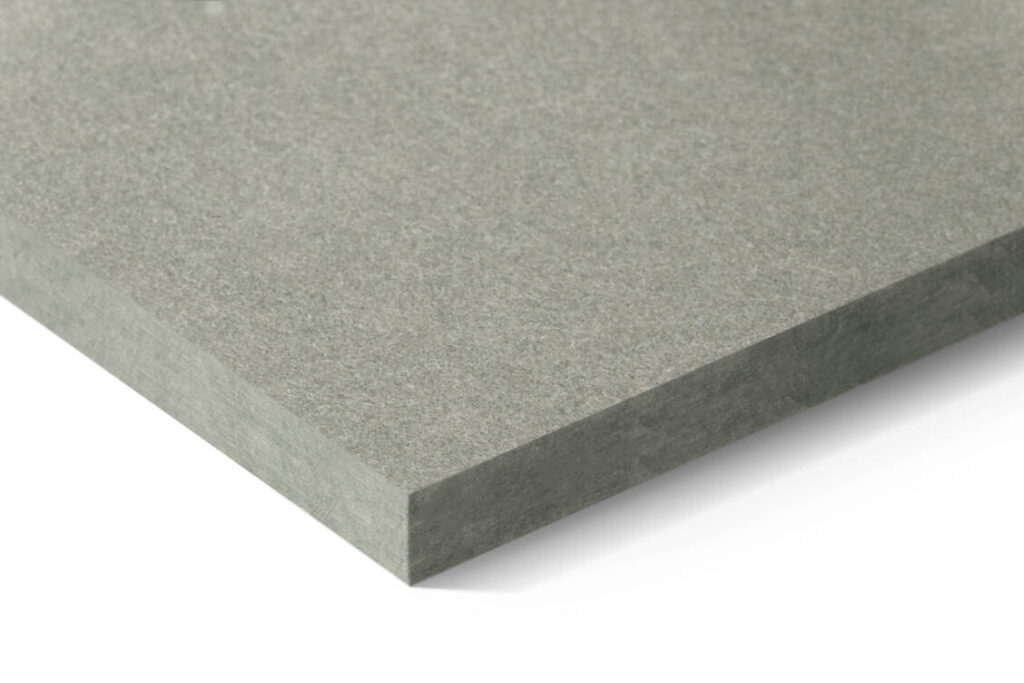
Swisspearl Construction is an untreated, high-density fiber cement building board. The authentic appearance of the rough fiber cement stands out on its natural gray, homogeneous face. It is used both as a building board and as part of a ventilated façade, and it can be installed as cladding where a natural, rough expression is wanted. In the US listing it is a commercial rainscreen substrate, and as visible cladding it forms the outer layer of the kind of wall covered by insulated wall and rainscreen systems.
The datasheet (Build Boards) is dated March 2023.
Material and appearance
The board is a natural material, and variations occur in individual boards and from board to board. The surface pH is 11. The face can be left natural or finished with a compatible vapor-permeable masonry or concrete coating. The US product page also describes dimensional stability, impact resistance and resistance to rot and fungal growth, and says the board is mineral-based and noncombustible.
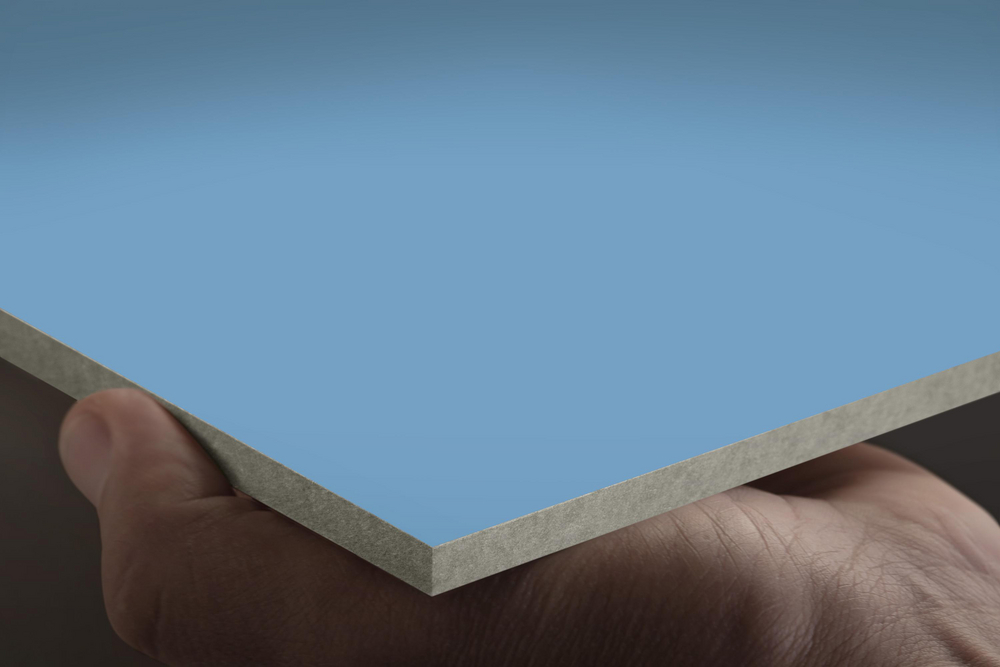
Unlike Windstopper Basic and Windstopper Extreme, which are backing boards behind a final cladding, Construction can serve as the visible face.
Data sheets and technical documents
Current files
Archived files
No older reviewed revisions are archived for this product yet.
Sizes and thicknesses
- The US listing covers 6 to 10 mm thicknesses, widths from 15.63 to 49.21 in and lengths from 47.52 to 120.08 in.
- Standard widths are 1192, 1200 and 1250 mm; lengths include 2500 and 3050 mm.
- Project sales sizes reach a maximum of 3050 mm in length and 1250 mm in width.
- The data columns cover 3.2, 4.0, 6.0, 8.0 and 10.0 mm.
- Tolerances (EN 12467): thickness +0.6 mm up to 6 mm, +0.8 mm at 8 mm and +1.0 mm at 10 mm; length +/- 3 mm; width +/- 2 mm.
Weight and density
Average dry density is 1800 kg/m³ and the minimum is 1550 kg/m³ (EN 12467). Average weight including 5 percent moisture rises with thickness.
- 3.2 mm: 6.1 kg/m²
- 4.0 mm: 7.6 kg/m²
- 6.0 mm: 11.3 kg/m²
- 8.0 mm: 15.1 kg/m²
- 10.0 mm: 18.9 kg/m²
Mechanical properties
- Bending modulus of elasticity, ambient: 21 GPa with the grain and 20 GPa across.
- Bending modulus, wet: 13 GPa with the grain and 9 GPa across.
- Bending strength, ambient: 26 MPa with the grain and 22 MPa across.
- Bending strength, wet: 20 MPa with the grain and 15 MPa across.
- Interlaminar bond, dry: at least 0.5 MPa at 6, 8 and 10 mm.
- Charpy impact strength at 6, 8 and 10 mm: 2.7 kJ/m² with the grain and 2.0 kJ/m² across.
Thermal and moisture properties
The coefficient of thermal expansion is 0.008 mm/m °C, the maximum temperature is 105 °C and frost resistance is above 100 cycles (EN 12467). Thermal conductivity λ10 is 0.48 W/(mK) at 8 mm. Water absorption is 12.0 percent and wet-dry-wet movement is a maximum of 3 mm/m.
Vapor transmission (EN 12572-C) varies with thickness.
- Z-value (GPa m² s/kg): 1.93 at 3.2 mm, 2.2 at 4.0 mm, 4.23 at 6.0 mm, 5.21 at 8.0 mm and 3.15 at 10.0 mm.
- Sd (m): 0.37, 0.43, 0.82, 1.01 and 0.61 for the same thicknesses.
- Vapor transmission (USPerm): 9.1, 8, 4.1, 3.4 and 5.6.
Fire performance
- Reaction to fire (EN 13501) on a metal subconstruction is A2-s1, d0 at 4.0 mm; on a wooden subconstruction it is A2-s2, d0 at 4.0 mm and A2-s1, d0 at 6, 8 and 10 mm.
- ASTM E136 flaming test: Pass at all thicknesses.
- ASTM E84 at 8 mm: flame spread index 0, smoke development index 10.
- CAN/ULC-S102-10 at 8 mm: flame spread rating 0, smoke development classification 5.
- Category and class (EN 12467): NT A3 I.
Impact resistance and attachment
Impact tests under ETAG 034 and ISO 7892 were run at 8 mm and 10 mm. In the hard body test, 1 joule is passed in Category IV, 3 joules in Categories III, II and I, and 10 joules in Categories II and I. In the soft body test, 10 joules is passed in Categories IV and III, 60 joules in Category II, and 300 joules in Category II. The 60 joule test is passed in Category I at 10 mm and not passed in Category I at 8 mm. The 400 joule test is not passed in Category I at either thickness.
The US page gives attachment options for aluminum, steel and wood support: aluminum rivets for aluminum framing, steel rivets or façade screws for steel, and stainless-steel façade screws for wood.