McElroy PBR-Panel 2008 roof profile
- Manufacturer
- McElroy Metal
- Product
- PBR-Panel roof section, McElroy drawing E5 (2007/2008)
- Status
- Archived
- Market
- United States
- Latest revision
- Not confirmed
- Latest file date
- Not confirmed
- Last verified
- September 24, 2026
- Archived files
- 2
The 2008 McElroy PBR identity
This record identifies a particular McElroy Metal PBR-Panel roof cross-section from the company's drawing E5, prepared June 11, 2007 and carried in Miami-Dade notice 08-1007.06, approved December 4, 2008. The approval was for a 24-gauge steel roof panel and expired December 4, 2013. Its date and manufacturer matter: PBR and R-panel describe a broad family of exposed-fastener sheets, while the exact folds and side laps come from a specific roll set. The drawing supplies a 36-inch cover with a stated tolerance of one-sixteenth of an inch, major ribs at 12-inch centers, and a one-and-one-quarter-inch major rib rise. That makes it possible to identify an existing sheet more closely than a generic R-panel description would.
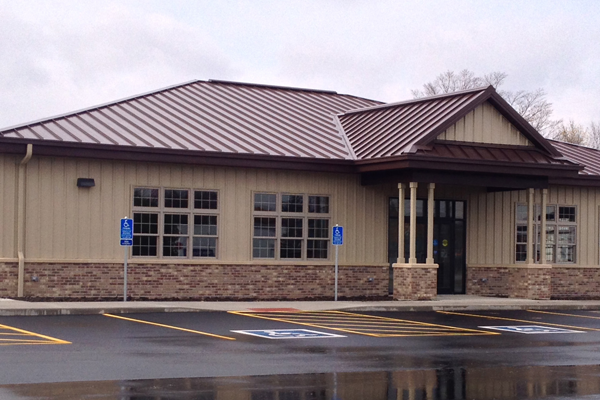
McElroy still markets an R-Panel family, and its current photo here is a representative view of ribbed McElroy roofing. The photograph does not establish that a sheet from today's production will mate with the 2007 profile. Use the dated cross-section, both side edges of an undamaged roof sample, and the one-page ordering sheet when requesting a replacement. The useful question for a supplier is whether its available die makes this exact lap and rib shape, including the small intermediate ribs, rather than whether it can make any panel with a 36-inch cover.
Reading the measured roof cross-section
Drawing E5 shows three 12-inch modules across the 36-inch covered width. The major rib has a one-inch typical crest flat and a one-and-one-quarter-inch typical rise. The intermediate features repeat on a four-inch module; the small raised rib is called out at one-quarter inch typical and its flat top at three-quarters of an inch typical. The drawing also marks a small recess at three-sixteenths of an inch typical. These little features affect how a light-transmitting replacement or adjacent metal sheet nests against the existing roof. A fabricator matching only the large trapezoid can leave the small ribs and pan geometry out of register.
The main web is marked 50 degrees typical, the outboard web is marked 55 degrees, and a minor-rib web is marked 30 degrees. Those are the angles printed on this McElroy drawing; they are not transcribed from another manufacturer's PBR sheet. Other chain dimensions shown around the detailed rib are 1.53, 0.69, 1.38, 1.42 and 3.07 inches, while the edge offset is marked 0.21 inch with a plus-or-minus 0.12-inch notation. Read these numbers in their positions on the linked E5 drawing before specifying a die. The one-page sheet carries the key callouts for a supplier inquiry, while the original drawing retains the placement of each chain dimension and the drawn edge details.
Historic metal grade and generation
The 2008 approval drawing names 24-gauge steel with a stated minimum thickness of 0.023 inch, minimum 50-ksi yield and 65-ksi tensile strength. Its material row identifies ASTM A792 steel with AZ 55 coating for bare material and AZ 50 for painted material, and identifies Kynar 500 as the paint coating in that approved assembly. Those are attributes of the dated 24-gauge panel in the archived approval, not a menu of every replacement sheet available now. For a metal replacement, record the existing steel thickness, coating condition, finish and length alongside the cross-section. A supplier can then quote a material and finish suited to the new order without assuming that matching the rib shape also matches the old material specification.
A separate McElroy technical bulletin from June 2006 names PBR-Panel and depicts the same headline 36-inch cover, 12-inch major spacing and one-and-one-quarter-inch rise, but its load table is for 26-gauge, 50-ksi material. That bulletin is included in the file section because it is an exact named manufacturer product PDF and useful period evidence. Its grade and load values are kept distinct from the 24-gauge E5 approval drawing. The archived approval date is a historical marker, not a current permit or current stock confirmation. A new order should be priced and checked against the fabricator's present material, tooling and project requirements.
Requesting a replacement metal sheet
Start by removing or exposing one sound panel end where both lap edges can be measured. Photograph the exterior and underside, keep a square section through the full cover, and mark which edge overlaps its neighbor. The quoted 36 inches is the installed cover, not the width of the flat coil before forming. Measure the panel's finished length from eave to ridge or between its actual end-lap limits, and note roof slope, support spacing and the position of any translucent sheet. The order should state quantity, metal gauge, substrate and coating, finish or color, panel length, edge hand, and whether a cut or uncut sample can be supplied. Send the official E5 drawing and the one-page profile sheet with that request.
Ask the roll-former to compare its crest width, major web angles, small ribs and side-lap folds against the McElroy sample. If it offers a standard PBR panel, request a short trial section and physically check both joints before a full run. An apparent match in cover width and rib height can still fail at the overlap or at a closure. A fabricated panel also has to work with the roof's present supports and fastening plan; the archived NOA's assembly details should be read as evidence of the old tested configuration. For project planning, the built-up metal roof installation service explains how the profile survey, sheet choice and installation sequence can be coordinated.
Requesting a matching GRP or fiberglass panel
A GRP sheet is a separate material request built around the same measured shape. Send the cross-section and an undamaged metal sample to the fiberglass producer, then state the desired transparency or opacity, color, nominal laminate thickness, panel length, quantity and delivery location. The supplier needs to assess whether it already owns a compatible pattern or would need new tooling. The 50-degree and 55-degree major web callouts, 30-degree small-rib callout, one-inch crest and side-edge offsets should be checked on a physical sample before accepting a prototype. The old steel load figures and approval do not specify a fiberglass product, and a visually close translucent panel may require different support or fastening details.
Dipcraft Manufacturing is one US fiberglass producer that invites sketches of existing corrugated metal panels and reviews custom forms according to its tooling and production quantity. Its published information distinguishes stocked patterns from new runs, so send both the one-page summary and original E5 drawing to receive a meaningful answer. A supplier reply should identify the selected pattern, sample fit, laminate thickness, finish, minimum order and expected length range. A Texas metal-panel shop can quote the metal replacement separately; its R-panel line does not establish that it manufactures GRP. Keeping the two requests explicit lets the owner compare a like-for-like metal sheet with a purpose-made light-transmitting replacement.
For a fiberglass match, request a profile review from Dipcraft Manufacturing.
Five Texas places to request a metal-panel quote
Metal Warehouse in Sherman publicly lists PBR panels formed to ordered lengths, making it a North Texas starting point. Xtreme Metals describes in-house R-panel work at its Flint-area East Texas operation. Quality Metals identifies PBR panels and roll-forming at its San Antonio facility. Lucid Metal Works in Houston lists R-panel among its metal roof profiles, and All Precision Metals in El Paso advertises R-panel roll-forming to ordered lengths. These five locations spread the inquiry across North, East, Central, Gulf Coast and West Texas. Each can receive the McElroy E5 and one-page sheet for a compatibility review; the published capability alone does not prove that any shop has the 2007 McElroy die.
The supplier list is a quote route, not a substitute for a profile check. Ask each shop to state whether its PBR sample matches the one-inch crest, the 50-degree and 55-degree major webs, the intermediate 30-degree features, and both side laps. Include a clear view of the existing roof and any transition to newer sheets. Request a trial length if the reply relies on a generic R-panel label. The five suppliers below link to their own service or profile descriptions, so the inquiry can go to the most useful branch with the complete drawing package. The separately listed fiberglass specialist covers the GRP path when a translucent sheet is needed.
- North Texas — Sherman: Metal Warehouse — PBR metal sheets formed to ordered lengths
- East Texas — Flint/Tyler: Xtreme Metals — in-house R-panel metal production
- Central Texas — San Antonio: Quality Metals — PBR panels and regional roll-forming
- Gulf Coast — Houston: Lucid Metal Works — R-panel profiles and roofing metal fabrication
- West Texas — El Paso: All Precision Metals — R-panel roll-forming to ordered lengths
Data sheets and technical documents
Current files
Archived files
Technical reference note
Verify current suitability, availability, engineering performance, certification, warranty, and installation requirements with the manufacturer and the project design professional before specification or construction. Archived files do not represent current requirements.