
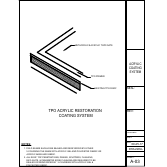
Acrylic Roof Restoration Coating System TPO
- Manufacturer
- Metacrylics
- Product
- Acrylic Roof Restoration Coating System TPO
- Status
- Current
- Market
- United States
- Latest file date
- September 25, 2017
- Last verified
- September 20, 2026
Overview
Acrylic Roof Restoration Coating System TPO is a Metacrylics system assembly for TPO roof membranes, finished with acrylic topcoats. It is an acrylic roof coating restoration system for existing TPO roofs.
The assembly is published as drawing A-03, titled TPO Acrylic Restoration Coating System, dated 09-25-17. The drawing shows an existing TPO roof, a TPO primer, and Metacrylics acrylic topcoats.
Assembly and layers
The drawing requires field seams to be sealed and reinforced either by 3-coursing the seam with Acrylic Gel and polyester fabric, or with Acrylic Base and fabric. All roof top penetrations, drains, scuppers, flashing, skylights and perimeter edge flashing are required to be sealed or reinforced by 3-coursing with Acrylic Gel and polyester fabric.
The acrylic application book gives the TPO or PVC systems as 10-, 15-, 20- and 30-year systems. The primer in all four is Metacrylics TPO Primer or Roof & Tile Primer at 0.3 gallons per square (1 SQ = 100 sq. ft.), with 4 to 12 hours to cure. The roof is pressure washed first.
- 10-year system: Acrylic White at 3 gallons per square in two applications of 1.5 gallons per square, with 24 to 48 hours between applications. Seams are reinforced with 9 inch Stitchbond fabric and Clear Acrylic Base, and waterways and ponding areas are reinforced.
- 15-year system: Clear Acrylic Base at 3 gallons per square, with 1 square of Stitchbond fabric per square. The base goes on at 2 gallons per square with the fabric embedded by brush or broom, then 1 gallon per square saturates it. Acrylic White follows at 3.5 gallons per square in two applications of 1.75 gallons per square.
- 20-year system: Clear Acrylic Base at 4 gallons per square in two layers of 2 gallons per square around embedded polyester fabric. Acrylic White follows at 4 gallons per square, in two applications of 2 gallons per square, with at least 24 hours between them.
- 30-year system: Clear Acrylic Base at 6 gallons per square, 2 squares of Stitchbond fabric per square in two embedded layers, and a 5-course penetration detail. Acrylic White goes on at 7 gallons per square in four applications of 1.75 gallons per square.
Data sheets and technical documents
Current manufacturer system specifications, application guidelines and component data sheets matched to this assembly.
Current files
Archived files
No older reviewed revisions are archived for this product yet.
TPO Primer
Metacrylics TPO Primer is an all-acrylic polymer for pigmented elastomeric roof coating basecoats, giving adhesion to weathered thermoplastic polyolefin membranes. It is intended for TPO membranes weathered at least four years. The TPO is pressure washed at 3,000 psi, after cleaning with a liquid cleaner such as Metacrylics EPDM Rinse or TSP in water.
Published values include viscosity of 127 KU, pH 10, density of 11.83 lb/gal, weight solids of 66.2% and volume solids of 52.0%. Tensile strength is 147 psi initially and 237 psi after 1000 hours of weathering, and elongation at break is 227% and 181%. Tear resistance is 79 lbf/in. Permeance face down is 7.0 perms, and water swelling after 7 days is 10%.
Adhesion figures (pli) are listed for several substrates, dry and wet: aged TPO 2.5 and 1.5, APP mod-bit 1.1 and 1.4, PUF 10.1 and 2.3, cement 5.5 and 1.3, galvanized steel 5.3 and 1.6, and aluminum 6.4 and 1.6.
The primer is flexible to -15°F (-26°C) and contains 50 g/L VOC. It is not applied at or below 5°C (40°F), above 90% relative humidity, when rain is expected, or on roofs collecting ponded water.
TPO Primer is sprayed or rolled and is supplied in 2-gallon, 5-gallon, 55-gallon and 275-gallon packages. It is for weathered TPO membranes only. Acrylic Clear Base is the primer path for PVC membranes.
Acrylic Gel
Metacrylics Acrylic Gel is a water-based acrylic elastomeric mastic for flashing and fabric reinforcement repairs. It comes in white, gray and clear. It is used on roof blisters, field seams, drains, scuppers, coping, splits, cracks, fishmouths, and perimeter base and curb flashings.
Published ratings and values: Cool Roof Rating Council C-1371 solar reflectance 0.87 and thermal emittance 0.90 (CRRC Seller ID No. 0660); ICC-ES listed Report No. 4785; UL Classified, Class A fire (ASTM E-108, UL Standard 790) and wind uplift of 105 PSF (Section 6 of ANSI A58.1); low temperature flexibility passing 1 inch at -40°F (ASTM C836); Shore A hardness 41; permeability 0.016 perms (ASTM D1653) at 81 mils dry film; weight 11.5 lbs/gallon; VOC 0.14 grams/liter; solids 67.31% by weight.
For a 3-course, a smooth layer of gel is applied over the area, fabric is pressed into it, and a smooth layer of gel goes over the fabric, with 12 to 24 hours of dry time. The field area is overlapped at least 2 inches and 2 inches up the penetration, curb or wall.
Extreme Performance Acrylic White
Metacrylics Extreme Performance Acrylic White is a white, water-based acrylic elastomeric coating with about 50% more TiO2 and 50% more copolymer resin than the standard acrylic white. It is used as a reflective coating over BUR asphalt, tar and gravel, granulated capsheet, metal, concrete, wood, foam, EPDM, TPO, PVC and stucco.
Initial elongation is 592.63% by ASTM D6083-05e1, and 521.12% at 23°C by ASTM D412 (Die C). Low temperature flexibility passes 1 inch at -40°F (ASTM C836). Cool Roof Rating Council values (C-1371) are solar reflectance 0.90, thermal emittance 0.88 and an SRI of 114. Weight is 11.3 lbs/gallon and VOC is 27.5 grams/liter.
Spray application is two coats at 1.5 gallons per 100 sq. ft. each, 3 gallons in total, with 12 to 24 hours between coats. Roller application is 2–3 coats at 1.33 to 1.5 gallons per 100 sq. ft. each. A non-skid finish is made by broadcasting sand over the wet coating or by mixing 1/2 gallon of #30 mesh sand with 2-1/2 gallons of the coating.
Related products
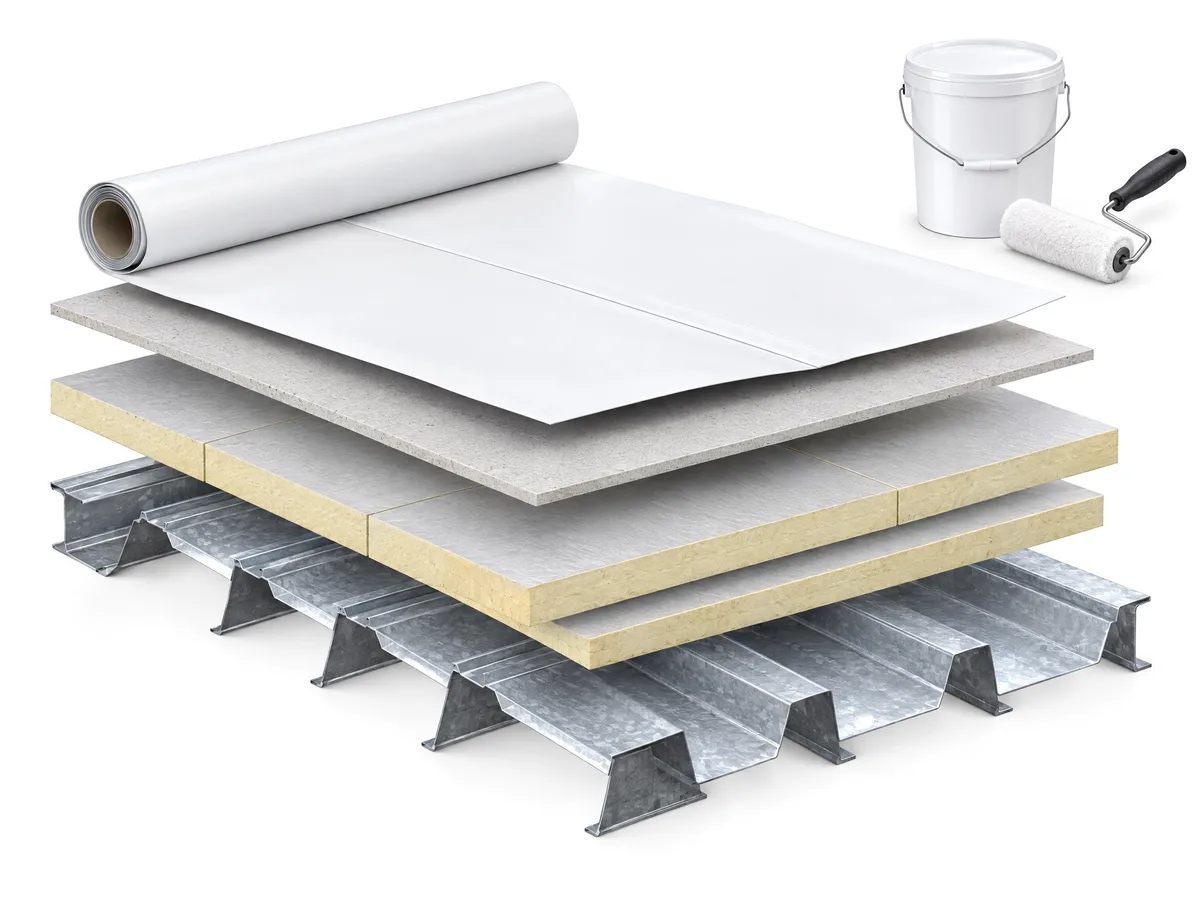 Illustration
07 56 00 Fluid-Applied Roofing Recover Sikalastic-646
Illustration SM-1P-XE — Acrylic-surfaced reinforced roof system
Illustration Pro-Grade 988 Silicone Roof Coating
Illustration CTG-3-1.5A — Aluminum-surfaced roof restoration system
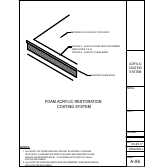
Acrylic Roof Restoration Coating System Foam
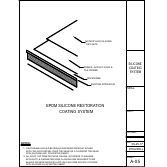
Silicone Roof Coating System EPDM
Contribution history
Published changes remain in this permanent record. Corrections create a new entry instead of deleting earlier history.
- September 21, 2026 at 8:48 amLibrary Record
Acrylic Roof Restoration Coating System TPO — initial source record
Created the system record and matched the current manufacturer system specification, application guidance and component data sheets.
By Tom · Verified Primary Source
Sources: Official Metacrylics Acrylic Roof Restoration Coating System TPO system page