Double Pipe Portal
- Manufacturer
- Portals Plus
- Product
- Double Pipe Portal
- Status
- Current
- Market
- United States
- Last verified
- October 14, 2026
Overview
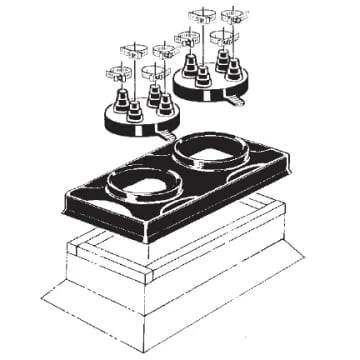
The Double Pipe Portal is a prefabricated pipe penetration flashing from Portals Plus, made to cover a group of pipes that pass through the roof at one location. One roof curb carries a single curb cover with two collared openings, and each opening is closed with its own molded rubber cap. A cap is cut at the step that matches the pipe diameter, slipped over the pipe or pipes and held to the collar by a stainless steel clamp.
Ten versions share the same curb and cover and differ only in which two caps are supplied: C-126, C-212, C-412 or C-481. The cap pairing decides how many pipes, and of what diameter, the portal can take. Pipe diameters covered across the ten versions run from .375 in. to 6 in.
The portal is one of the penetration flashings used to finish pipe openings on flat and low-slope roof assemblies, where the roof membrane is flashed to the curb in line with the roofing membrane manufacturer's recommendations.
Versions and cap combinations
Every version is furnished for the pipe groups below. The part number is the cover-and-caps kit, packed 2 per carton, and the description reads "Double Cover & Caps" with black caps.
- C-212 and C-481 caps (part 36062): up to six pipes .375 in. to 1 in. in diameter and two pipes 1 in. to 2 in.
- Two C-126 caps (part 36032): two pipes 2 in. to 6 in. in diameter.
- C-126 and C-212 caps (part 36002): up to two pipes .375 in. to 1 in., up to two pipes 1 in. to 2 in. and one pipe 2 in. to 6 in.
- C-126 and C-412 caps (part 36012): one penetration 2 in. to 6 in. and up to four pipes in the range written as .1 in. to 2 in.
- C-126 and C-481 caps (part 36022): one penetration 2 in. to 6 in. and up to four pipes .375 in. to 1 in.
- C-212 and C-412 caps (part 36052): up to two pipes .375 in. to 1 in. and six pipes 1 in. to 2 in.
- C-412 and C-481 caps (part 36102): up to four pipes .375 in. to 1 in. and four pipes 1 in. to 2 in.
- Two C-212 caps (part 36042): up to four pipes .375 in. to 1 in. and up to four pipes 1 in. to 2 in.
- Two C-412 caps (part 36092): up to eight pipes 1 in. to 2 in.
- Two C-481 caps (part 36142): up to eight pipes .375 in. to 1 in.
Only the C-126 caps take a pipe larger than 2 in., so the three versions with a C-126 cap are the ones for 2 in. to 6 in. pipes. The versions built from two C-412 or two C-481 caps hold the highest pipe count, eight.
Data sheets and technical documents
Current files
Archived files
No older reviewed revisions are archived for this product yet.
Curb, cover and cap construction
The specification for all ten versions describes the same build:
- An 18-gauge galvanized roof curb, model RC-___A, with an integral base plate and continuously welded corner seams.
- A factory-installed wood nailer on the curb.
- 1.5 in. of 3 lb. rigid fiberglass insulation in the curb.
- A laminated, acrylic coated ABS plastic curb cover with prepunched holes and molded sealing rings on two 8 in. collared openings.
- Two EPDM (Ethylene Propylene Diene Monomer) compression molded caps.
- Stainless steel Snaplock Clamps on all caps.
Attachment and installation are done in accordance with Portals Plus' instructions and the roofing membrane manufacturer's recommendations.
Curb models and dimensions
The curb is chosen to suit the deck. Three models are listed with the portal, each with a 12 in. x 27.5 in. opening size and 1.5 in. insulation walls:
- RC-2A, for decks with lightweight fill or tapered insulation, is a straight sided curb 11 in. or 18 in. high.
- RC-3A, for non-insulated decks, is a canted curb 8 in. high.
- RC-4A, for decks with rigid insulation, is a raised canted curb 9 1/2 in. high.
Curb part numbers are 32161 for the DBL RC-2A 11 in. high, 38161 for the DBL RC-2A 18 in. high, 32171 for the DBL RC-3A and 32181 for the DBL RC-4A. Each is packed 1 per carton.
The curb cover measures 13 in. x 28.5 in. and stands 4 in. high. Its two 8 in. collared openings sit 15.5 in. apart, center to center.
Cap steps and pipe diameters
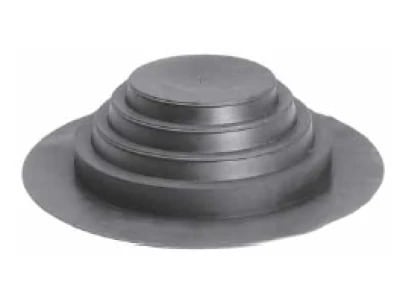
Each cap is molded as a stepped cone, and the pipe sizes it takes are set by the inside diameter of its conical nipples. The step is chosen to fit the pipe, and the nipple is cut off above the index ring.
The C-126 cap has five steps, taking inside diameters of:
- 2.35 in. to 3.00 in.
- 3.40 in. to 4.20 in.
- 4.40 in. to 4.60 in.
- 5.50 in. to 5.60 in.
- 6.50 in. to 6.65 in.
The C-126 cap is 5.5 in. tall at its top step, and its steps stand at 4.75 in., 4 in. and 3.25 in. above a 1.5 in. base.
The C-212 cap carries two sets of nipples. The larger set steps through 1.30 in. to 1.70 in., 1.80 in. to 2.00 in. and 2.25 in. to 2.40 in. The smaller set steps through 0.65 in. to 0.90 in., 0.97 in. to 1.10 in. and 1.275 in. to 1.375 in.
The C-212, C-412 and C-481 caps, with their smaller sets of nipples, are the ones used for pipes of 2 in. and under.
Installation steps
Installation runs in six steps:
- Step 1: Check parts so that all necessary components are available.
- Step 2: Flash the curb in accordance with the roof manufacturer's recommendations, then slip the curb cover over the pipe or pipes and seat it on the curb.
- Step 3: Nail or screw the curb cover to the curb using the prepunched holes in the cover.
- Step 4: Select the proper step on the rubber cap to accommodate the pipe or pipes being used, and cut off the nipple above the index ring.
- Step 5: Slip the cap down over the pipe or pipes and onto the collar. Press around the edges to be sure the rubber cap is properly seated around the beaded ring of the collar.
- Step 6: Install the stainless steel clamp around the rubber and tighten the screw. Installation is then complete.
The rubber cap is not intended to support the pipe.